
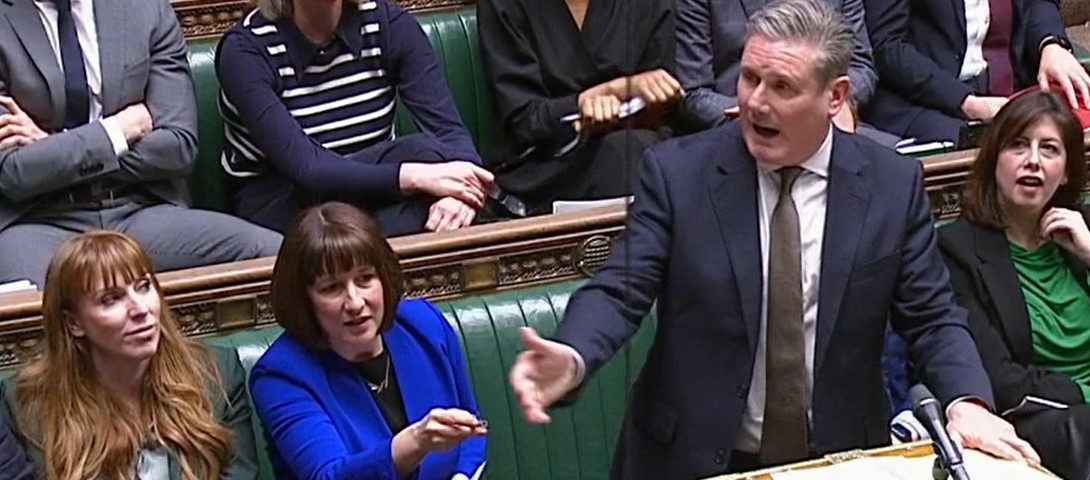
The election of a right wing-dominated Labour government in July opened up a new and extremely turbulent stage in modern British politics, although its full effects will not become evident immediately. There will be two major developments that socialists will need to take account of. The first is the rise of the far right in UK politics, to unprecedented levels of support, as a result of the failure of the government to address the insecurities felt by working people. (See our editorial on Reform UK here)
The second will be growing discontent, leading at a later stage to upheavals in the Labour Party, as its working class roots – particularly the membership of its affiliated unions – push back against the Tory-lite agenda of Keir Starmer and Rachel Reeves.
Supporters of Keir Starmer in the Labour Party – and there are still a few of them left – are dreading 2025, because every economic and political indicator is pointing at his failure. As the Financial Times on December 20, noted, “Coupled with two consecutive months of economic contraction, resurgent inflation, a worse productivity problem than previously thought and falling business sentiment, the chancellor is set for a perilous 2025”.
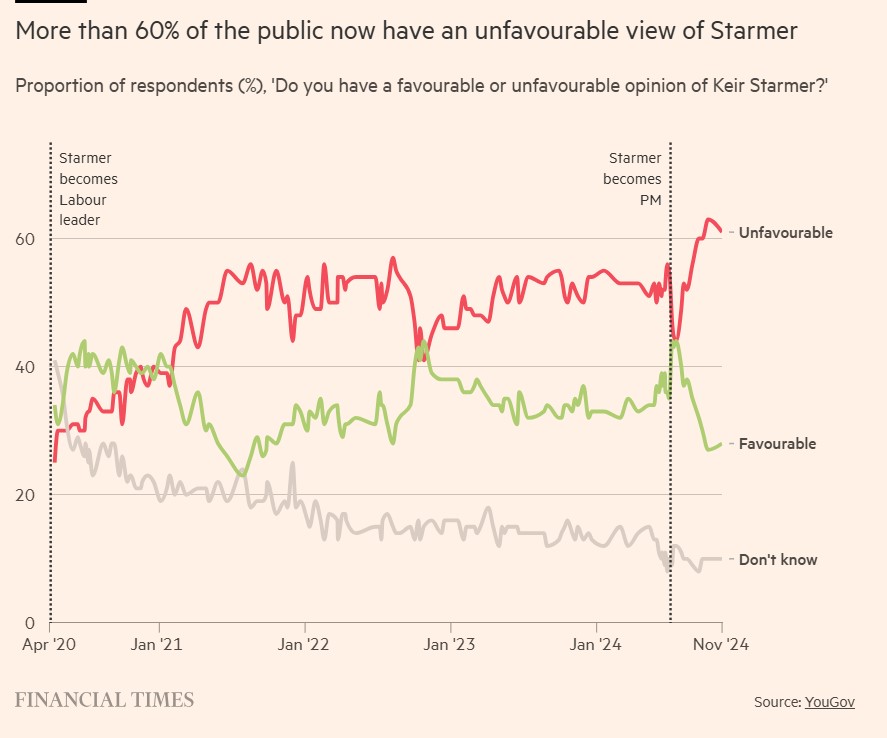
As 2024 has drawn to a close, therefore, even ‘insiders’ in the upper echelons of the party are beginning to acknowledge that Starmer has become a complete disaster. There is no other example in modern times of a Prime Minister’s losing so much support so soon after being elected. Less than six months on from July 4, Starmer has a negative personal rating of minus 62.
Local by-elections show Labour’s support nose-diving
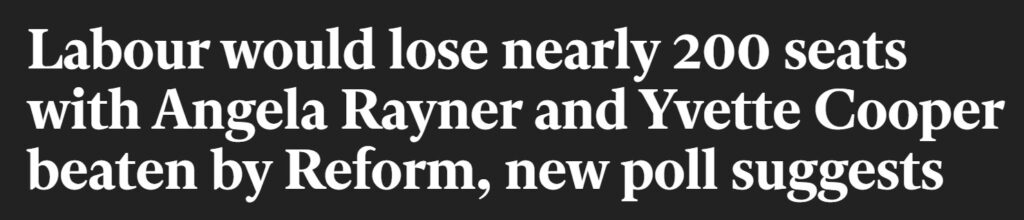
A new poll for the Independent reveals that on the basis of today’s figures, if there were a general election now, Labour would lose over 200 seats, including those of senior ministers. Reform UK would emerge as the third largest party. “Labour” the article in the Independent explains, “…would lose 87 seats to the Conservatives, 67 to Reform UK, and 26 to the SNP…”
Writing in the Guardian, Owen Jones commented on local government by-elections and noted that “Since the July general election, Labour has lost 22 seats. Attentive staffers on the call note that the picture is bleaker than the headline figures suggest, because even where Labour has retained seats, the party’s share of the vote is invariably plummeting by a fifth. Nigel Farage’s Reform party is surging, with the Greens posing a growing threat on Labour’s left flank”.
Already, although they are completely in the ascendancy in the Parliamentary Labour Party and within the machinery of the party, Labour’s right wing are beginning to feel a cold draught. At local level, right-wing councillors must realise by now that on the basis of current trends, come the elections in May, they’ll be toast.
There are many MPs and ministers who keep their thoughts hidden from the membership of the Labour Party – honesty and transparency have never been the strong-points of mainstream politicians – but they are always willing to cry on the shoulders of their friends in the media when times get hard. On condition, of course, of complete anonymity.
Six months after the election – universal gloom among Labour MPs
The Financial Times last week (December 24) was full of such revelations and soul-searching comments from Labour ‘insiders’. The paper claimed to have spoken privately to ministers, aides and Labour MPs about Keir Starmer’s coming year and there is almost unanimous gloom. “There is now widespread agreement in Number 10 and the Treasury”, the reporters conclude, “that the £1.5bn cut in winter fuel payments for 10mn pensioners in late July was a major political mistake, which sowed the seeds for many of the government’s later problems”.
That decision, the frightened whispers suggest, “fuelled a sense around Starmer’s new government that Labour would be little different from the Conservatives…Starmer’s acceptance of £32,000 of freebie suits and glasses added to that narrative”. John McTernan, arch-right winger and a former Labour Downing Street aide, openly confessed to the FT, “Cutting winter fuel payments was an egregious error because it was done out of context, in the long, four-month gap between election and Budget. It had a fundamental impact on fixing a perception of this government.”
The whole policy of Labour’s right wing is to manage capitalism better than the Tories. They have no perspective or policy beyond the so-called ‘market’ system and despite polls regularly showing massive popular support for the public ownership of utilities, when it comes to policy, they cannot get beyond the headline writers of the Mail and the Express.
“…discussing who might replace Starmer…”
The net result, according to the FT’s listening ears, is that already, “some Labour MPs have started discussing who might replace Starmer and lead Labour into the next election”. It was no less than a government minister who said to one FT reporter that “People [meaning Labour MPs] are super-nervous about Reform,” As well they might be.
Despite their woebegone pessimism, Labour’s right wing still do not really understand why they are in such a fix. They believe that the current low polls are matters of “presentation” and “perception”. One senior Labour figure told the FT, “We may have done the right thing but we’ve lacked a story to explain why we’re doing these things.” But it is not the absence of a “story” or the psychology or personal weaknesses of leaders that are undermining Labour, like Reeves and Starmer not being “upbeat” people (McTernan). It is the cold, hard reality of an economic system driven by profit and greed.
Even the relatively modest ‘hit’ on business in the October budget, in the form of higher employers’ National Insurance payments has led, in effect, to a strike of capital, and a refusal by big business to invest in higher productivity, which is the fundamental cornerstone of Reeves’ economic policy.
Any ‘radical’ policy bitterly opposed by big business
The Marxists in the Labour movement warned when Labour was elected that any even remotely ‘radical’ policy would be bitterly opposed by the ruling class and that is already proving to be true. Capitalism controls the media, two main parties, Tories and Reform, the House of Lords, the judiciary and police, the army and the tops of the civil service.
All of these, without exception, are opposed to even a right-wing Labour government, not for the policies it espouses, but for the millions-strong labour movement that looks over its shoulder and the possibility that this will push the government into more radical measures.
Whereas Starmer’s faction controls the Labour apparatus and parliament, it does not control the rank and file of the trade union movement. The only way to bring right wing trade union leaders on board, was for the Labour leadership to promise a “new deal” for workers within the “first hundred days” of office. That promise is hanging by a thread, as an already watered-down bill looks like being further diluted in parliamentary committee. What new rights will remain will not see the light of day until 2026.
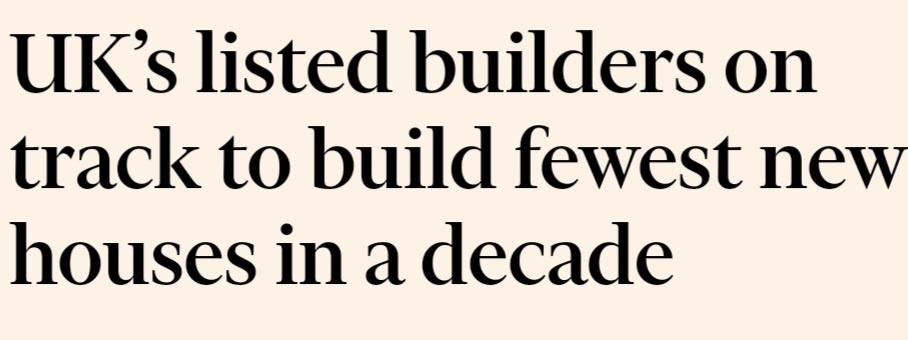
All the indications are that the government in 2025 will shift the balance of its spending priorities even further in the interests of business at the expense of necessary public services. The latter are already in a parlous state and with the government pledging to increase expenditure on Defence, they are likely to be squeezed further.
Public sector workers, and workers who rely on public services like education, health and transport will feel their living standards under pressure. Privatised utilities like water and energy will continue to fleece consumers, even while paying dividends to shareholders. The “hard choices” that Starmer and Reeves talk about will translate in 2025 into austerity Mark II.
The economic realities of British capitalism will begin to bite
When Labour won the election in July, our editorial immediately warned, “by the time of Reeves’ first budget as Chancellor in September, the economic realities of British capitalism will begin to bite. That will spell more austerity – this time ‘Labour’ austerity, dressed up as “hard choices” – and the beginning of a change from ‘wariness’ and ‘scepticism’ to anger”.
That editorial also made the point that “Capitalism has nothing to offer workers except blood, toil, tears and sweat. Those who want to transform capitalism into a more ‘benign’ version of itself will fail”. That will become increasingly obvious in 2025.
Outside the ranks of the labour movement, the confusion, uncertainty and insecurity that grips many workers, will lead to what appears to be an easy answer, as support for Reform UK. A surge of support for that party, on the same scale as the growth of support for right-wing populists in France, Germany and other countries, is a foregone conclusion, given the failure of the Labour leadership to challenge capitalism.
But inside the ranks of the labour movement, among its hundreds of thousands of activists, trade union officers and reps, it is far more likely that there will be a shift in the opposite direction, to the left. They will see their living standards pummelled yet again, while the one important commitment made to them – on improved rights at work – is kicked into the long grass.
Because of their back-tracking on environmental policies and the government’s disgraceful silence on the Israeli genocide in Gaza, Labour is likely to lose even more support among younger voters and Muslims. A part of the growing opposition to Starmer, therefore, will be reflected in more support for left independents and the Green Party. Nonetheless, despite the forlorn hopes of those ultra-lefts who only have one hymn-sheet to sing from, there will be no new mass workers’ party to the left of Labour.
The main focus of opposition to Keir Starmer, and the movement with which Left Horizons will associate itself, will be through the trades unions primarily and then, through them, into the Labour Party itself. An increased freedom of debate and discussion will inevitably result from the discontent within the labour movement and that is something that we can look forward to in 2025.











I have to agree with John the Labour Party is far from finished. However much the left outside organise and get favourable results the fact remains that Labour has a strong residue of support in working class communities despite not because of the wonderful leadership of Starmer and Tweeting. Its is because the left allowed themselves to be driven out of structures of the party that temporarily Starmer et al seem invincible at the moment. THIS WONT LAST. Labour historically is political expression of organised working class in Britain the only serious development of Marxism in Britain was the Militant tendency in the 1970s and 80s because they understood this tenacious fact and built on it.
There are loads of sunken shipwrecks of so called wevolutionay parties hanging around the periphery of the movement. There haven’t achieved much because they seen by the workers as just that “on the periphery “. The latest example the Semi Stalinist Revolutionary Communist Party of Alan Woods and Rob Sewell will despite it’s current success will end up in the doldrums.
Revolutionaries need to constantly test themselves in the movement to understand its moods and tempos in order to gain the ear of the advanced working class only then can win the confidence of wider layers and pave the way for socialism
After a very good critique of Labour under Starmer, the conclusion seems st odds with that analysis. It assumes that it’s still worth fighting to change the Labour Party from the inside. Yet not least, the last few years of expulsions strongly suggest it’s not. What we need is a new radical type of left party. The days of continuing to sow illusions in the Labour Party as a vehicle for progressive change are over. Whilst it won’t be easy to build a new party, it should not stop us & conditions are more favourable than in decades I.e. deep disillusionment with Starmer, 5 independent MPs, some good election results for others & the collapse in Labour Party membership etc. Since before & after the July election a range of groups have been trying to do this, around the electoral Left List involving groups like Transform & Collective.
You are wrong on so many levels, Peter. This editorial isn’t a comment on what the ideal solution might be, it is a prognosis about what is likely to happen…whether we wish it or not. If you think it likely that a new “radical type of left party” (whatever that means), at least as a mass party, is going to be formed, you’re living a dream, despite the “favourable” conditions. The editorial doesn’t “sow illusions” in the Labour Party; it simply starts from the real world situation as it is, not as we’d like it to be – and the Labour Party is FAR from dead. As Left Horizons has said many times, Starmer is not the Labour Party and the Labour Party is more than just Starmer. You’d be making a big mistake to think otherwise.
There is a long tradition of Labour Party supporters saying this leader is not a genuine Labour Party leader, it started under Kinnock, at least in my adult life, and so we must fight to get a proper Labour leader. It’s this illusion that keeps some to the Labour Party. I didn’t say the LP is dead, but it’s not worth fighting to save. I’m committing myself to building a new type of radical campaigning electoral party. The revolutionary left has some great comrades, but it’s moribund, smaller, (& probably older) & more marginal than in probably 40 years or so. If we want to stop Reform we also need to offer an electoral alternative to it.