The latest in our occasional series of articles by ANDY FORD on 80-year anniversaries of events in WW2 in the Soviet Union and Eastern Europe.
********
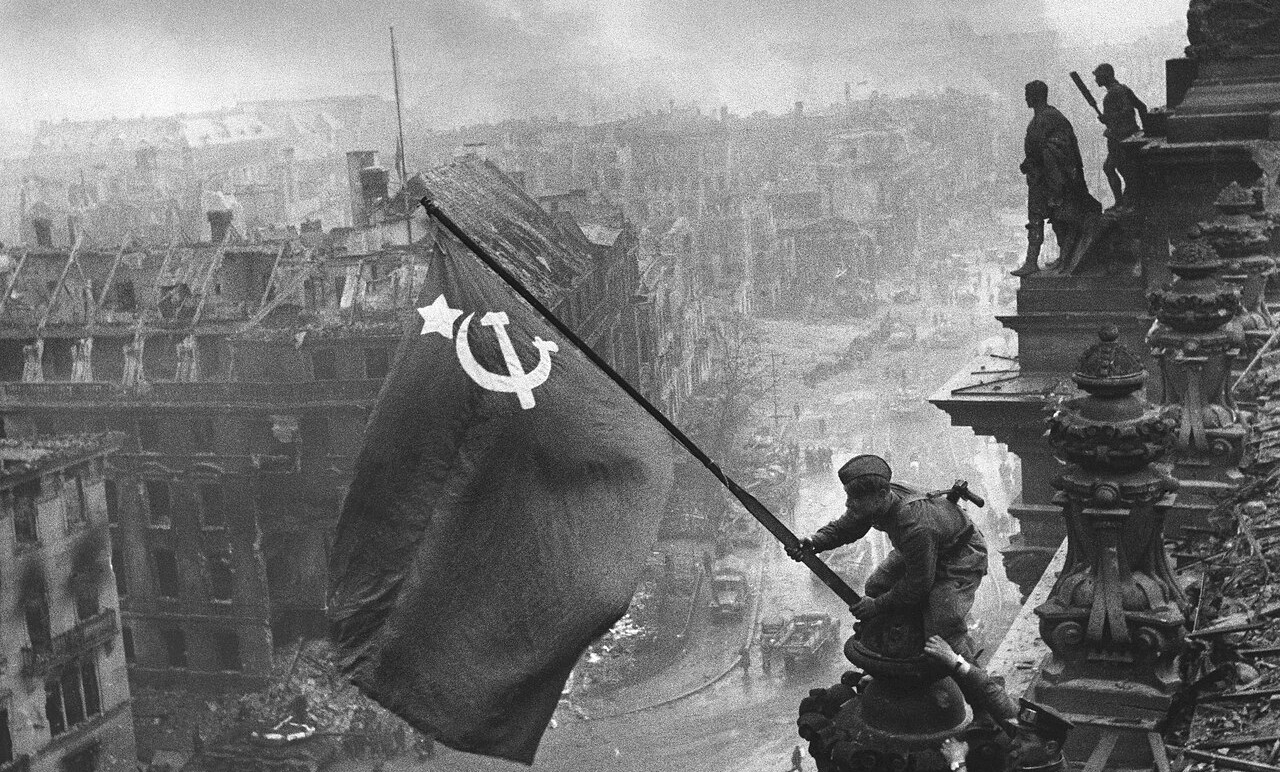
The battle of Berlin was the end of Hitler’s ‘Thousand Year Reich’ – after just twelve years. Hitler himself committed suicide on April 30th blaming everyone else except himself – and the city was surrendered two days later.
The war launched by the Nazis, acting for German big business, had cost around 50 million dead in the European theatre, including 19 million Soviet civilians, 8.7 million Soviet soldiers, 7.5 million Germans, 6 million Jews, 5 million Poles and other European civilians, and 3.8 million Soviet prisoners of war. Now, in April 1945, the Red Army stood on the eastern bank of the River Oder, just 60 miles from Berlin.
The Soviet armies had reached the Oder in late January 1945. When Stalin had blocked Marshal Zhukov from moving forward to Berlin while it lay undefended [see Left Horizons article here], STAVKA, the Soviet high command had used the subsequent two months to crush German resistance in East Prussia [see Left Horizons article here] and to laboriously assemble a huge force to finally occupy the Nazi capital.
In fact, the Russian force organised for the Battle of Berlin was almost as big as the German and vassal armies that had attacked the Soviet Union three and a half years before across a front of hundreds of miles [see Left Horizons article here]; it comprised 2.5 million men, 41,000 artillery pieces and more than 6,000 tanks. The Red Air Force (VVS) also had near-total command of the skies over the city.
The race for Berlin
From the start, Stalin saw the battle for the Nazi capital as a race with the western allies. Seeing Reuters reports of mass surrenders of German troops to the allies on the western front, he became gripped with a paranoia that Hitler would open his lines to the British and Americans, while fighting to the death in the east.
He wanted the glory of destroying the Nazi regime, but also Berlin housed interesting and valuable resources such as the Nazi nuclear programme, its chemical weapons stores, and who knew what other ‘wonder weapons’ rumoured to have been cooked up by the German military.
But Stalin also set the battle up as a race between his two commanders – Generals Zhukov and Konev, At the beginning of April he held a meeting with the two, asking “Who is going to take Berlin, us or the allies?”
“It is we who will take Berlin” was Konev’s reply, promising to take all the necessary measures to reposition his forces, so putting his rival, Zhukov at the disadvantage [Konev, ‘Year of Victory’, quoted in ‘Berlin’, Antony Beevor]
In this, Stalin had form, as in 1920, in the Civil War, out of petty political rivalry, he had disobeyed orders at the Battle of Warsaw to co-ordinate his southern army with the main Red Army forces commanded by General Tukhachevsky, resulting in a crucial Polish victory over the USSR. This ultimately led to the Polish frontier being set hundreds of miles to the east.
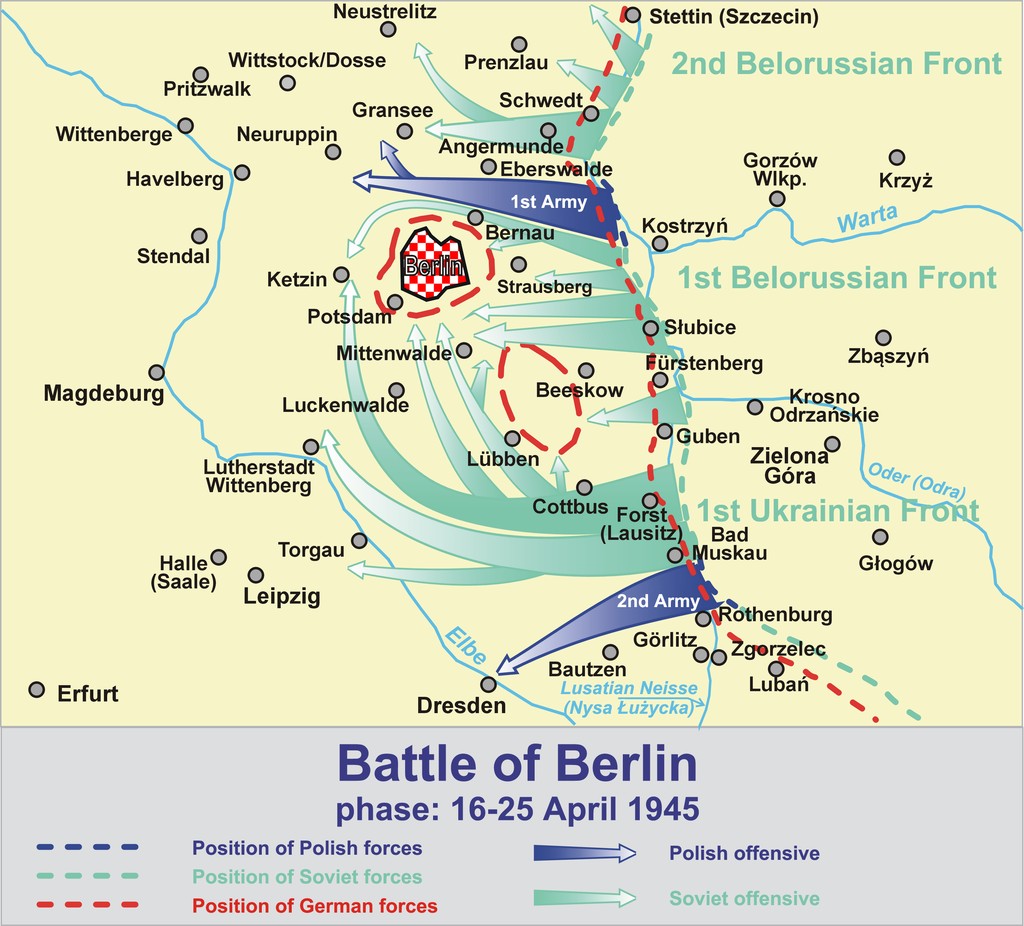
Zhukov, commanding the 1st Belorussian Front, was to attack Berlin from the east, down the main road from Warsaw; while Konev, commanding the 1st Ukrainian Front, was to cross the River Neisse 80 miles south of Berlin and swing north to encircle the city.
Outstanding defensive tactician
Zhukov was at the obvious point of attack, perhaps too obvious, and he faced one of the Wehrmacht’s outstanding defensive tacticians in General Gothard Heinrici. He could see exactly what Zhukov’s plan would be and so he fortified the low hills between the River Oder and Berlin, the Seelow Heights, deploying his IX Army of just 100,000 men in three lines of defence. The first was at the point where the river flood plain ended and the terrain began to rise, and was held by a light screen of troops. The second was on the higher points of the Seelow Heights, and the third was on the plateau behind.
Battle was opened on 16th April with a huge artillery barrage on the first and second lines of defence. It was truly overpowering, with buildings shaking in Berlin, 60 miles away, and when the Soviet forces moved forward from their marshy positions on the flood plain all they found were dead and wounded, and shell-shocked survivors wandering around the blasted landscape. But Heinrici, catching wind of the date of the attack had pulled his forces out of the second line, only to send them back at the end of the barrage.
When the Red Army tanks started moving up the hills towards the top of the Seelow Heights, they were met with withering fire from Heinrici’s reinforced second line positions. In the rear of the Russian attack, the very size of the forces assembled became a problem with traffic jams, confusion as units lost contact with their staffs, and evacuation of the wounded shockingly slow.
Zhukov began to panic, shouting and swearing, and even threatening demotion of his officers to penal battalions. In desperation, by 3 pm he had decided to throw caution to the winds and ordered his tanks to attack ahead of the infantry, creating chaos and entirely preventable losses of tanks and their crews. There were also numerous friendly fire incidents and bombing of Red Army units by their own air force.
At midnight on the 16 April Zhukov had to admit to Stalin that he had not even reached the tops of the Heights, but was still bogged down. He promised that success would come the next day, on the 17th, which put even more pressure on him and his commanders.
Crossing the River Neisse
On the 17 April, Stalin ordered Konev’s 1st Ukrainian Front to cross the River Neisse. After an artillery barrage of nearly three hours, twice as long as Zhukov’s, the Red Army men got in their boats and crossed the river at over a hundred points. The German defenders could simply not withstand it and the Russians crossed with few losses, following up with the construction of a number of steel bridges for efficient supply.
Once across the river they found the open country almost undefended. One spearhead moved west to meet the Americans on 25th April at Torgau on the River Elbe [captured in this quite beautiful film] while the main force swung north, approaching Berlin from the south.
Finally, at 9 am on the 18 April elements of Zhukov’s Front broke through the last German line of defence at Seelow. His desperation, brute force and unimaginative tactics had cost the lives of 30,000 Red Army soldiers, comparted to German losses of 12,000. However, from the 19th the whole German defence on the Seelow Heights gradually collapsed as those units who held the line increasingly found themselves about to be surrounded.
The road to Berlin filled with panic-stricken German soldiers fleeing back to Berlin and those elements of the German IX Army who maintained their cohesion were gradually forced back into the Spree Wald, an area of forest and heathland south of Berlin. By the 22 April they were encircled there, caught between Konev’s 1st Ukrainian Front and Zhukov’s 1st Belorussian Front. This deprived Berlin of any organised military force for its defence.
Hitler – downfall and suicide
It was on this day, that Hitler had the hysterical and tearful breakdown depicted so famously in the film ‘Downfall’. After shouting and screaming at his generals for not defeating the overwhelming Soviet forces he collapsed into apathy. All his ineptitude and self-delusion had been laid bare for everyone to see, and he shuffled off into his private quarters. On 30 April he committed suicide.
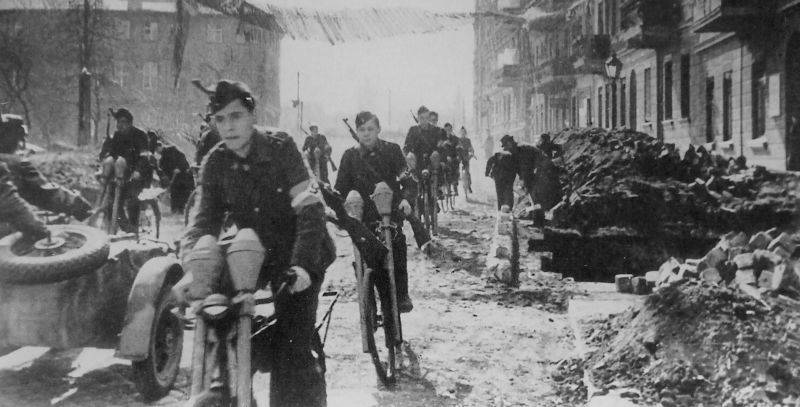
Meanwhile the surrounded IX Army tried to escape to the west, to surrender to the Americans, but was more or less destroyed in the Battle of Halbe Forest from 25th April to 1st May. Of an original force of 90,000 men, only 30,000 made it to the American lines. 24,000 are buried in the war cemetery in Halbe and the remains of the others are still being dug up today.
The defence of Berlin against a Soviet force of hundreds of thousands was now left to a motley collection of Volk Sturm ‘home guard’ type formations; Hitler Youth, each armed with one or two Panzerfaust (a portable anti tank weapon); the Berlin police force; and fanatical German and foreign Waffen SS legions totalling a mere 45,000.
Between 10,000 (German estimates) or 25,000 (Soviet estimates) German civilians and soldiers were executed at impromptu roadside court martials for ‘cowardice’, desertion, opposition to Hitler or simply being in the wrong place at the wrong time. Meanwhile the top Nazis themselves began slipping away as best they could.
Berlin was surrendered on 2nd May.