by John PIckard
It is common for far right organisations in the UK and in Europe to be labelled as ‘fascist’ when they are nothing of the kind. It might be true that these parties – Reform and Restore in the UK, National Rally in France and the Brothers of Italy, for example – have individual members who are fascists. But the parties themselves are not re-runs of 1930s fascism.
This has been marvellously demonstrated by the 3,500 workers of the secretariat of Italian Prime Minister Giorgia Meloni, who were on strike last week over a new diktat limiting their right to work from home.
The Financial Times carried a report of the one-day strike among the workers of a secretariat that works exclusively for the office of Giorgia Meloni, Prime Minister and leader of the right-wing Brothers of Italy party. The workers are mostly long-term, professional, administrative and clerical staff and they are dispersed over twenty different buildings in Rome.
The management of the secretariat wanted to impose a new limit of home-working of only 52 days a year, half the current number. “Striking employees” the FT reported, “complain of the difficulty of working in government offices, where they say they are distracted by overcrowding, poor maintenance and pest infestations — including pigeons and Asian hornets”.
Workers complained about offices that were “dilapidated and uncomfortable, with poor temperature control”. In hot weather, they were unable to open windows, when the air-conditioning didn’t work because of nearby hornets’ nests.
The workers’ union, the “leftwing” USB explained that the reduction of home-working increased commuting costs “directly affects staff working conditions”, eroding work-life balance. Even employees who were still entitled to more home-working – such as the mothers of young children – came out in solidarity with their fellow workers.
1930s: Italian labour organisations smashed
The reason why this strike is noteworthy, is that it is right at the heart of the government of Meloni, who some on the left mistakeny describe as a ‘fascist’. She may certainly aspire to the political strengths of Mussolini’s movement, but she is far from it at the moment.
Philip Morgan’s book, Fascism in Europe, 1919-1945, describes how the fear of a resurgent working class after the First World War led the ruling class to finance fascism. “Often directly financed and equipped by local farmers and business associations, the [fascist] squads systematically destroyed by violence, intimidation and pressure the socialists’ organisational hold over agricultural labour and their control of municipal councils”
Month by month, the Italian fascist movement, more or less openly armed by the police and the army tops, took over cities and municipalities, attacking socialist and trade union offices, and beating up or killing activists. Eventually, Mussollini was able used to consolidate a dictatorship, and within a couple of years, the organisations of the working class no long existed, their leaders imprisoned or dead.
It was inconceivable for Mussolini to have be voted out of office after 1922 when he consolidated dictatorial power, although in the end it was a revolutionary resurgence over twenty years later, which led to the coup that unseated him.
Far from being smashed to bits, today the Italian labour movement under Meloni is still well organised – and strong enough to cripple the secretariat of the Prime Minister. Given Meloni’s complete failure to meet the needs of Italian workers, including those conned into voting for her party, there is every likelihood that, unlike her predecessor, she could be voted out of office at the next election. Far from being cowed by Meloni’s prime ministership, workers and becoming angrier and more determined.
This is a small lesson for socialists everywhere, and not least in the UK. Should someone like Nigel Farage get to Ten Downing Street after the next election, it would represent a serious setback to workers and it would pose a serious threat to living standards, public services and democratic rights.
But it would not at that point mean the destruction of the labour movement and new opportunities would arise for a renewed and reinvigorated trade union movement to fight back and fight back hard.
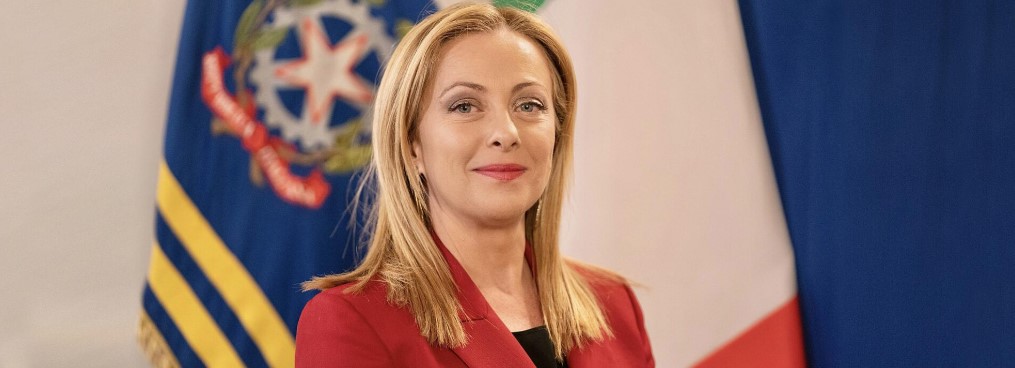
[Feature picture of Giorgia Meloni is from Wikimedia Commons, here]