By Andy Ford
In July 1946, eighty years ago, the first shots were fired in the Chinese Civil War on the North China plains. The war ended in 1949, with the establishment of the Peoples Republic of China, led by Mao Tse-Tung. A quarter of humanity were freed from imperialist domination; China was unified and land reform was implemented: capitalism was overthrown in the world’s most populous country. The revolution of 1946-50 laid the groundwork for the later rise of China as an economic and military superpower, a fact that now dominates the world economy and geo-politics.
The Civil War was preceded by a long period of revolution and counter revolution. In 1911 the feudal Qing dynasty collapsed and was replaced in the First Chinese Revolution by a weak nationalist government inspired by the democratic ideas of Sun Yat-Sen, and his party, the Kuo Min Tang (KMT).
But China at that time was crushed by the demands of the imperialist powers – Britain, France, Japan and the USA – who looted its resources and refused to allow China to choose its own path. The KMT could not unify or develop the country, and gradually degenerated into the party of the landlords and corrupt business classes led by Chiang Kai-Shek.
A second revolution followed in 1927, where the Chinese Communist Party (CCP) attempted to overthrow the capitalist government and establish a Soviet Republic, modelled on the Russian revolution of 1917. But, because of Stalin’s mis-leadership, the CCP made numerous mistakes and their revolution was crushed. Thousands of CCP members were executed.
Trotsky wrote a huge body of work on this episode [Leon Trotsky: Collected Writings on China]. Each one of these articles is important for anyone trying to understand how ‘China went Communist’ in the way it did, burdened with distortions and contradictions, and under a dictatorial leadership.
Peasants revolt
After the defeat of the Second Chinese Revolution, the remnants of the CCP fled to the countryside where they placed themselves at the head of the peasants’ revolt against the intolerable conditions they were being forced to live in by the corrupt capitalist regime in China. In some regions, the peasants’ taxes had been collected 100 years in advance! Mao was the CCP leader who best understood and appreciated the importance of the peasants’ movement:
“The present upsurge of the peasant movement is a colossal event. In a very short time, in China’s central, southern and northern provinces, several hundred million peasants will rise like a mighty storm, like a hurricane, a force so swift and violent that no power, however great, will be able to hold it back. They will smash all the trammels that bind them and rush forward along the road to liberation. They will sweep all the imperialists, warlords, corrupt officials, local tyrants and evil gentry into their graves. Every revolutionary party and every revolutionary comrade will be put to the test, to be accepted or rejected as they decide. There are three alternatives. To march at their head and lead them? To trail behind them, gesticulating and criticizing? Or to stand in their way and oppose them? Every Chinese is free to choose, but events will force you to make the choice quickly.”
[REPORT ON AN INVESTIGATION OF THE PEASANT MOVEMENT IN HUNAN, March 1927]
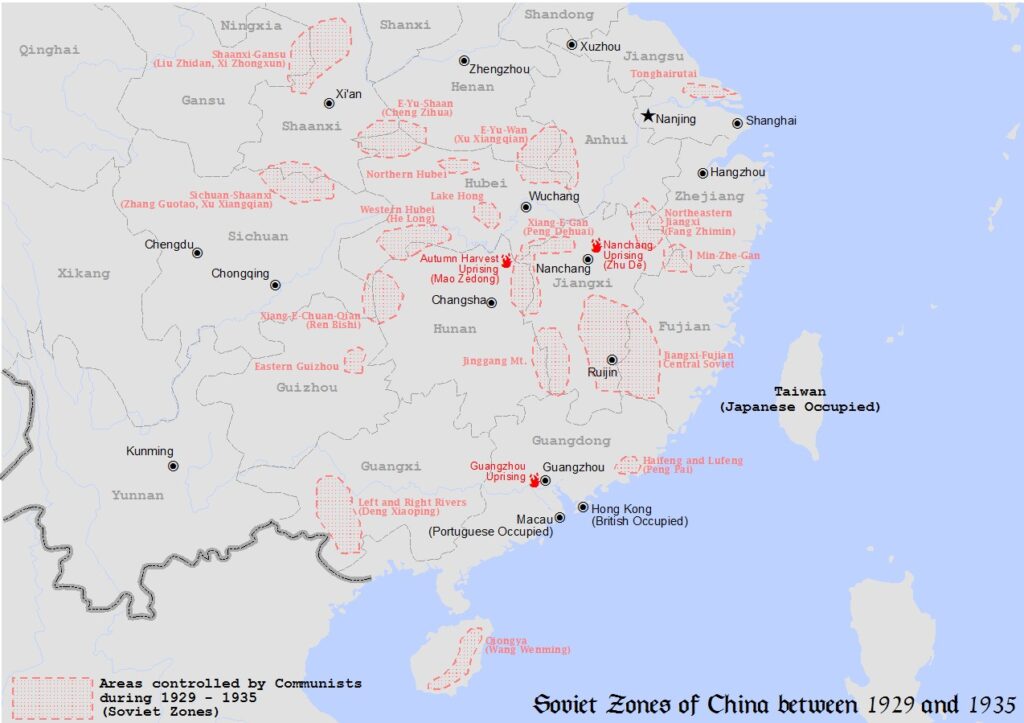
Mao found, in a single province, that 10 million peasants had organised their own independent military formations as protection against tax collectors, corrupt landlords and warlords. At the head of these peasant militias, the Communist Party grew, and by the mid-1930s were running several ‘liberated zones’ where they, in effect, were the government.
Mao erroneously called them Soviets, but Trotsky urged his supporters not to criticise the terminology, but to recognise the reality:
“If the revolutionary Chinese peasants today call their fighting organizations “soviets” we have not reason to give up the name. We must simply not get intoxicated with words. To believe that the soviet power in essentially rural regions can be an important, stable revolutionary power is to give proof of great frivolity.”
Leon Trotsky: A Strategy of Action and Not of Speculation (1932)
KMT ‘extermination campaigns’
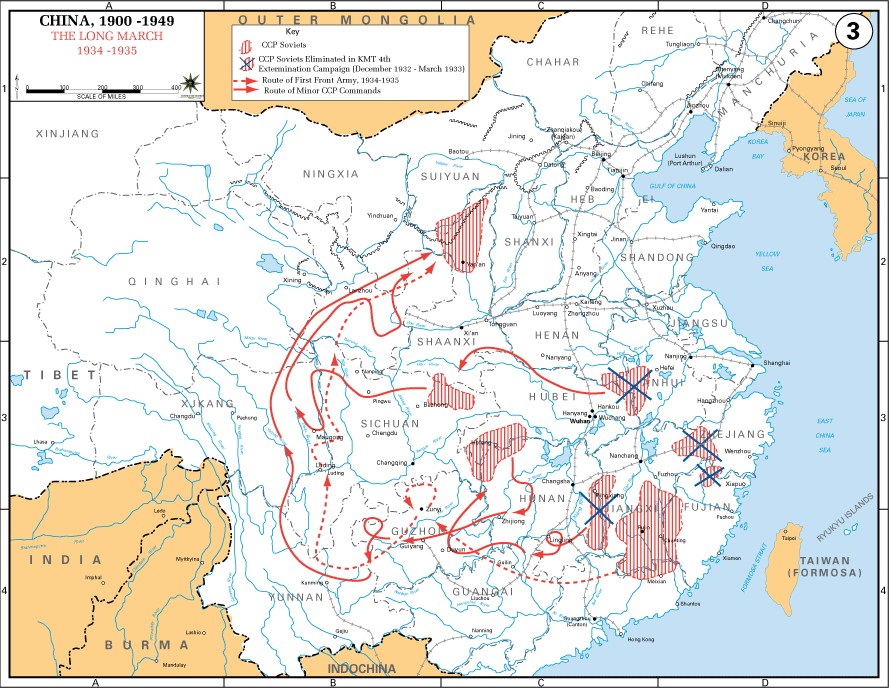
Despite the Chinese capitalist government led by the KMT launching ‘extermination campaigns’ against the rural Soviets, they were not totally successful. About a quarter survived into the late 1930s, and even when they were ‘exterminated,’ the CCP maintained guerilla forces in their former strongholds. The largest, the Jiangxi Soviet in south-eastern China, was overrun, at the fifth attempt and huge cost, by KMT forces in October 1934, but Mao led the Red Army on a journey of 6,000 miles (the ‘Long March’) to another liberated zone in Shaanxi, North China, and so preserved at least the core of his army.
When Japan invaded China in 1937, the CCP was able to use the accumulated experience of guerilla warfare to fight the invaders. But it was not just a military struggle. More important was the political struggle. In the rural areas where their guerillas had liberated the peasants from the Japanese, the CCP entered into a programme of radical land reform. In the liberated villages the peasants were assembled, the mortgages and title deeds were burnt, and the land redistributed to the villagers. Most landlords and gentry had run off to the towns to collaborate with the Japanese, but any landlords who remained were put on trial at village assemblies and either exiled or shot. In this way the CCP built up a huge base of popular support behind the Japanese lines.
Meanwhile everyone could see that the KMT forces and government only fought the Japanese when they had to, choosing to preserve their forces for a showdown with the communists. In addition to which, the KMT was riddled with corruption, dependent on foreign aid, and pillaged the peasants wherever they were in control. Matters got so bad that Chiang Kai-Shek was arrested and threatened with execution by his own troops unless he agreed to co-operate with the Communists against the Japanese in the ‘Xi’an Incident’ of December 1936, after which he reluctantly concluded a truce with the Communists.
This uneasy truce lasted until the ‘New Fourth Army Incident’ of January 1941, in which the head quarters of the Communist New Fourth army was treacherously attacked by the KMT as they made an agreed move north of the Yangtse River. 80,000 KMT troops surrounded the Communist force of 9,000, and effectively destroyed it. After that, there was no truce, just an absence of all out civil war. The survivors of the New Fourth Army rebuilt it so that it became the main communist guerilla force south of the Yangtse by 1945.
At the time of the Japanese surrender in 1945 the CCP guerillas were active across most of middle China, its most populous provinces. In these regions the Japanese controlled the cities, towns, ports and railways; the CCP controlled the countryside.
Collapse of Japan
Another factor which helped Mao and the CCP was the sudden collapse of Japan after the use of atom bombs by the USA, and the invasion of Sakhalin, Korea and Manchuria by the USSR. [see article here]. The KMT and Chiang Kai-Shek had expected another year of the war to allow them to build up their US-supplied forces ready to wipe out the Communists, and had also been promised a US intervention where thousands of marines would occupy the main Chinese ports.
Instead, from August 1945, the Japanese forces in China, and their puppet state armies, now began surrendering to the local Chinese military commanders. As the CCP had been battling the Japanese Army across the provinces of Hebei, Henan, Anhui, Jiangsu and Hubei, it was often the CCP to whom the Japanese surrendered, along with their weapons, ammunition and vehicles. In addition, many of the peasant soldiers of the Japanese puppet forces elected to join the CCP army, now renamed the Peoples Liberation Army (PLA), on the basis of the CCP programme of land reform.
In May 1946, after the Soviet forces had more or less completed their removal of much on Manchuria’s industrial infrastructure, Stalin instructed General Rodion Malinovsky, commander of the Red Army occupying Manchuria, to allow the CCP forces to occupy the Manchurian territories vacated by the Red Army as they withdrew. Along with the territory, the PLA also picked up huge amounts of abandoned Japanese equipment.
But Stalin did not do this out of sympathy for Mao and the Chinese communists, let alone to forge a socialist revolution in China. He intended to create a buffer state in Manchuria and northern China, as a protection for his bureaucratic rule in the USSR. He had already done this in the western Chinese territory of Sinkiang [see article here]. Stalin even went so far as to conclude a Treaty of Friendship and Alliance in August 1945 with Chiang Kai-Shek, the communists’ mortal enemy.
The developing situation filled Chiang Kai-Shek and his patron, the US, with alarm. The CCP now had an army of 1.2 million, backed by peasant militias of a further 2 million. They controlled a quarter of China’s territory and a third of its population, and had re-equipped their forces with seized Japanese weapons. Many puppet army soldiers and even KMT units had defected en masse to the People’s Liberation Army complete with their US supplied weapons. The People’s Liberation Army was no longer a rag bag force of peasant militias.
Government of national unity
But 1945 was too early for the intended massacre. The US therefore treacherously invited Mao and the CCP to form a ‘government of national unity’ with Chiang Kai-Shek and the KMT. Shamefully so did Stalin! The result was the ‘Double 10th Agreement’ (as it was signed on 10th October 1945) by which each side promised no aggressive action against the other, the CCP recognised the KMT as the governing party, and in return, the KMT recognised the communists as the official opposition.
In the following months Chiang Kai Shek and the US made their preparations to wipe out the communists once and for all. 40,000 American Marines occupied the main Chinese ports and US aircraft flew thousands of KMT troops to Manchuria and northern China. The US even organised Japanese troops, the former occupiers of China and authors of brutal campaigns such as the ‘Kill All, Burn All. Take All’ campaign of 1944, as a trained and battle-hardened auxiliary force to maintain capitalism in China.
In President Truman’s memoirs he openly admits re-arming Japanese troops:
“It was perfectly clear to us that if we told the Japanese to lay down their arms immediately and march to the seaboard, the entire country would be taken over by the Communists. We therefore had to take the unusual step of using the enemy as a garrison until we could airlift Chinese National troops to South China and send our Marines to guard the seaports.”
[Memoirs Volume 2: Years of Trial and Hope 1946-50]
The French did exactly the same in Vietnam. The whole episode shows that for all their talk of a war for freedom and democracy; the true war aims of the western allies were the continuation of their control and plunder of China and the whole Far East. Their problem with Japan was only that they would not share the plunder, and that they seized it first.
The KMT were able to land thousands of soldiers in Manchurian ports under the protection of the US Marines, and went on to secure the two big Manchurian cities of Shenyang and Changchun, and the railways connecting them. However, the People’s Liberation Army managed to maintain control of Harbin, a city of 800,000 people.
After the competition for territory and clashes of 1945, the stage was set for the open conflict of 1946.
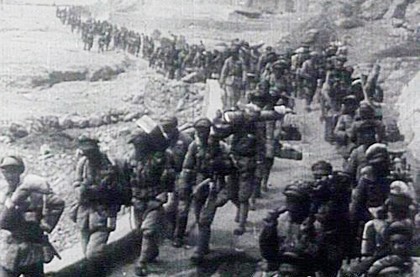
[Featured photo of marching soldiers at Yu Hanan from the 1946 Civil War – wiki commons]