The latest in a series of articles by ANDY FORD on 80-year anniversaries of events in WW2 in the Soviet Union and Eastern Europe.
**********
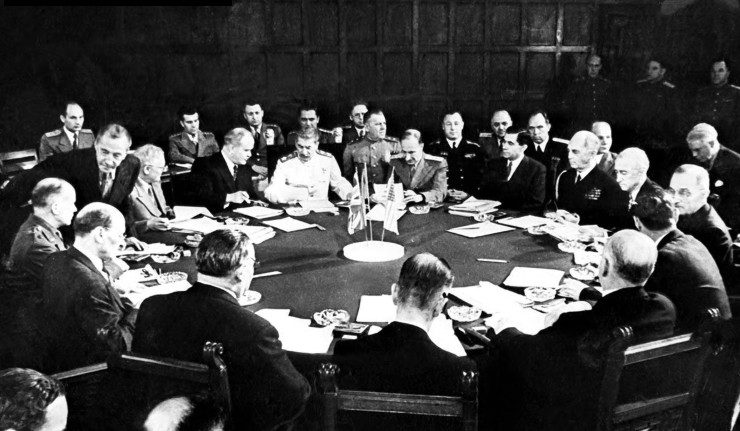
The Potsdam Conference of July-August 1945, nine weeks on from the Nazi surrender, further solidified the structure of post-war Europe into two rival blocs, based on opposing political and economic systems.
Although the unity of aims between the Stalinist USSR and capitalist western allies was still just about holding due to the need to finally defeat Japan, behind the scenes the cracks were appearing. A façade of unity was maintained by secrecy over much of the conference’s deliberations. The British Socialist Appeal commented:
“The Big Three are meeting secretly at Potsdam to decide the fate of Europe and the world. They meet behind closed doors. The proceedings at these meetings are kept secret from the peoples whose destinies are being decided…Extraordinary precautions are being taken to prevent the slightest information from leaking out, or even what is being discussed. ..And of course, there is very good reason why the Big Three should take this course. The horse deals, the intrigues, the dividing of the world into spheres of influence, the conspiracy being hatched against the European Revolution – would represent an unedifying spectacle to the masses of the world if conducted openly before their eyes”
[Socialist Appeal, July 1945 Supplement]
The forces working in the background were, firstly, the desperation of the US and Britain for Stalin to make good on his Yalta promise [see LH article here] to attack the Japanese Empire in the Far East, despite the two countries having signed up to an official neutrality pact in April 1941; secondly, the successful test by the US of the world’s first atomic bomb, on July 16th 1945; and thirdly, the Red Army’s physical control of the territory of all of the nations of Eastern Europe, with the exception of Yugoslavia and Albania.
Stalinist repression and occupation
The Stalinist secret police, the NKVD, had been busily repressing the anti-Nazi resistance forces in Poland, who were effectively abandoned by the US and Britain in return for Stalin’s promise to invade Japanese-occupied Manchuria in north-east China. The Baltic States were not even mentioned and were subject to Stalinist repression and occupation for the next 45 years, and due to the need to secure Soviet assistance for the final showdown with Japan, Stalin was able to rebuff all attempts of the western allies to influence events in Czechoslovakia, Hungary, Romania and Bulgaria.
In return, Stalin gave a free hand to the suppression of the resistance in Greece by British imperialism. With fateful consequences for the future he also agreed that Vietnam was to be divided at the 16th parallel with the Japanese occupiers to surrender to Chinese forces in the north and French forces in the south.
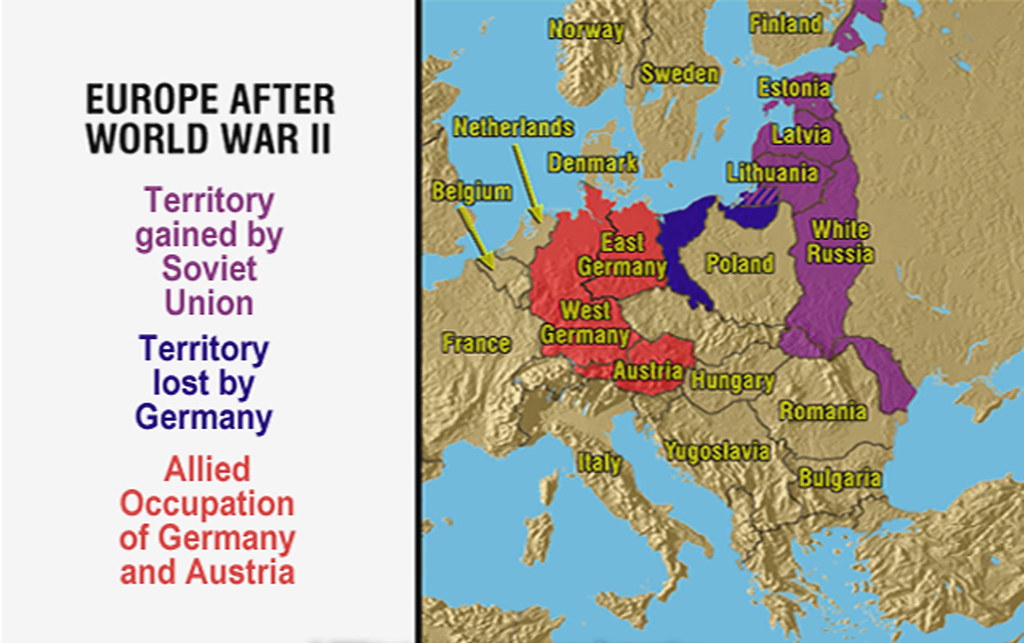
The conference confirmed the division of Germany into four occupation zones administered by Britain, France, the USA and Soviet Union with the Russian zone closely following the line reached by the Red Army in May 1945; Stalin told the Americans and British that if they wanted the French to have a zone it would have to come out of their share. Each of the victors could extract their war reparations from their ‘own’ zone.
The western Allies did not want to repeat the mistakes of Versailles in 1919. In President Truman’s words,
“We do not intend again to make the mistake of exacting reparations in money and then lending Germany the money with which to pay. Reparations this time are to be paid in physical assets”.
[Truman speech to the American radio, August 1945].
Stalin took full advantage of this idea and the eastern zone of Germany was virtually stripped bare.
The conference also agreed to Stalin’s demand to shift Poland’s borders 150 miles to the west. This involved the expulsion of tens of thousands of ethnic Germans who had survived the Stalinist’s rampage through East Prussia and Poland in the winter of 1945 [see LH article here]. In eastern Poland, in the ethnically mixed Polish/Soviet borderlands, the Polish inhabitants were removed and the Soviet Union moved its border back to the ‘Curzon Line’ of 1919.
Expulsion of Germans
The conference called for an “orderly and humane” expulsion of Germans from the territories of Poland and Czechoslovakia, so recognising the disorderly and inhumane expulsions which had been happening since the end of declared hostilities on May 8.
In Czechoslovakia particularly, there were 3 million ‘Sudeten Germans’ who had lived there for centuries under the Austro-Hungarian Empire. The war had ended in Czechoslovakia with the Prague Uprising of the 5-9 May where the Czech resistance eventually freed the city (with help from a rebellion of Russian troops enlisted under the Nazi banner as the ROA).
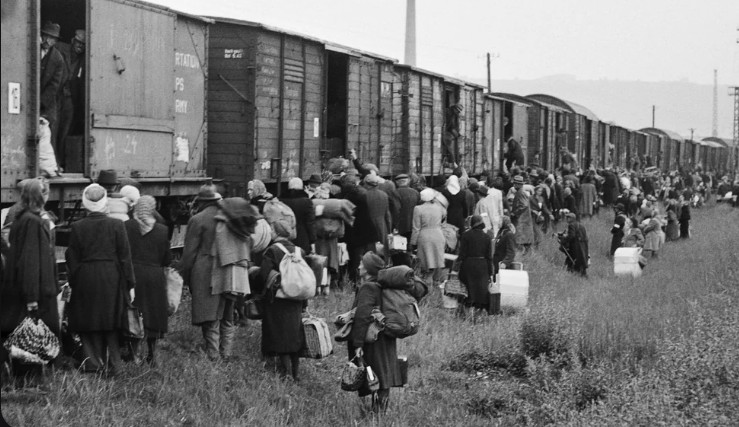
After the defeat and evacuation of the Wehrmacht in Prague the fighting had spilled over into collective revenge against German civilians across the country. The lead in the call for attacks on the German minority was taken not by Czech nationalists, or even the Stalinists, but the so-called ‘democratic’ government in exile headed by the ‘statesman’ Eduard Benes, the pre-war premier of Czechoslovakia.
On his return from London, Benes took to the radio holding the German minority collectively responsible for the crimes of Nazism in Czechoslovakia, saying, “Take everything from the Germans. Leave them only a handkerchief to weep into”, leading to lynchings, arson attacks and destruction of homes across the country.
He issued a series of decrees, the ‘Benes Decrees’ which stripped Germans and Hungarians of their Czech citizenship, expropriated their homes and businesses and transferred any farmland they owned to “the original Slavic inhabitants”, unless they could prove activity in the anti-Nazi resistance. Interestingly, his decrees made no mention of expulsion from the country – that was left to mob violence.
In most cases German civilians were confronted at gunpoint, robbed of their valuables, and told to leave, maybe with a suitcase. In one instance, authorities in the Czech city of Brno forced 20,000 ethnic Germans to walk roughly 40 miles to the nearest border in May 1945. Some 1,700 of them died on the march.
The overall death toll was something like 300,000, due to malnutrition, disease, cold and physical attacks. It was all the more unjustified because the Sudeten Germans, being mainly industrial workers, had a significant minority who resisted the Nazis and called for working class unity with Czech workers [see here].
Massacres and pogroms
Newly liberated Czechoslovakia was scarred by a series of massacres and pogroms, as Czechs sought vengeance for their treatment by the Nazis – such as the total destruction of the Bohemian village of Lidice in June 1942. But even within such horrible events there were signs of empathy and working-class solidarity across the divide.
At Usti nad Labem, on the Czech border with Germany, about 80 German civilians were lynched after a suspicious explosion on July 31 1945. But although the killings were led by Czech paramilitaries, ordinary Czechs living in the town tried to warn their German neighbours, sheltered those fleeing and even fought the paramilitaries. Anti-German hatred wase not natural but had to be whipped by politicians. The ‘suspicious explosion’ itself is now attributed to elements of the Czech interior ministry as the signal for a pre-planned massacre [See new evidence here].
Potsdam set up the framework for the Nuremburg war crimes trials of senior Nazis, intended to record and punish those responsible for the horrific crimes uncovered at the Nazi concentration camps by the allied armies, and the massacre and starvation of civilians all over Europe. However, at exactly the same time, the US military and intelligence were secretly setting up Operation Paperclip to transport Nazi rocket scientists back to the USA for their own rocket programme.
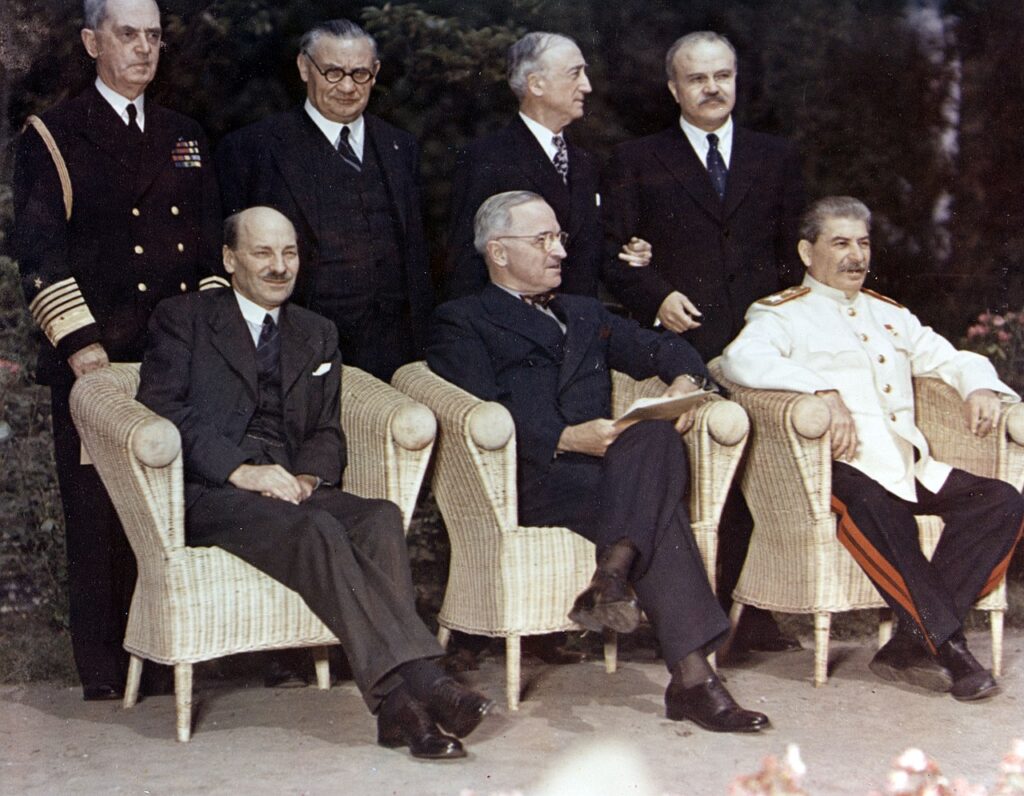
On July 26 the American, British and Chinese delegations issued a joint demand for the unconditional surrender of Japan or else to face “complete destruction”. Truman attempted to intimidate Stalin by telling him that the Americans now possessed a weapon of “unusually destructive power”, but Stalin, who knew of the atom bomb from his spies, kept his composure, merely replying “Make good use of it against the Japanese”.
The failure of the Japanese to reply to the ultimatum led to the use of the atomic bombs on Hiroshima and Nagasaki on the 6 and 9 August 1945. Stalin and the USSR were still officially neutral.
In the light of modern evidence, Potsdam shows the hypocrisy of the great powers who publicly proclaimed the war as one for freedom for the peoples of the world, whilst in reality they were traded like betting chips in a casino.
[Featured photo from U.S. Naval History and Heritage Command]