By Joe Langabeer
Industry, a co-production between the BBC and HBO, is a drama that examines the chaotic and corrupt lives of young bankers working for an investment bank in London. It is currently airing its fourth series and has provided an excellent fly-on-the-wall view of what life is really like for those who serve, and are part of, the capitalist class.
I would highly recommend people to watch it, even if it is often crass and depraved in its depiction of behaviour, showing how these people use and hurt each other in the name of money and power.
The show is written by Mickey Down and Konrad Kay, former investment bankers, who were initially passionate about the industry while training at Oxford, but who learned to hate it once they were inside it. In a piece from The Financial Times discussing the parallels between the show and real life, Kay and Down said that much of the dialogue, ranging from comical to downright macabre, was mined from their own experience on the trading floor.
While some bankers believe aspects of the show are “overdone”, others quoted in the same piece see themselves in it and describe it as broadly accurate to the kinds of events that occur in the financial trading world.
The series begins with graduate bankers who have entered finance determined to climb the ladder of corporate success. Yasmin and Harper, the two protagonists, possess different skills that help them “succeed” at the bank.
Harper is a self-described “capitalist at heart”, someone who wants to take every opportunity available to get ahead, even if it comes at the expense of others. Yasmin, meanwhile, is born into wealth through her father’s publishing empire and benefits from that privilege, including access to the best schools and ultimately securing her a job at the fictional investment bank, Pierpoint.
There is also Eric Tao, the trading floor manager, who has spent decades at the company. He is ruthless in his beliefs and a bully, a misogynist and a racist to anyone who might get in his way. He forms a mentorship with Harper, but the relationship is warped.
Eric attempts to undermine her once he realises she is also pursuing power. This dynamic becomes increasingly fascinating as the series progresses, particularly because neither of them truly holds power. Instead, they serve as cogs in a huge wheel controlled by the CEO, partners and shareholders of the firm.
The first episode opens with a dramatic statement of intent. We follow Hari, a graduate attempting to impress his boss and the trading floor by working through the night, drinking vast amounts of energy drinks and even sleeping on a filthy toilet floor. By the end of the episode, Hari suffers a heart attack and dies, making it clear from the outset that this is a bleak and unforgiving show.
The first season then deals with the ramifications of Hari’s death, alongside a supposed attempt to change the “culture” of Pierpoint, though this quickly turns out to be a ruse. After one of the firm’s clients attempts to sexually assault Harper, she initially tries to cover it up in order to continue building her reputation, only to later use the incident as leverage to keep her job when management shifts.
The new management, who performatively present themselves as kinder to their workers, ultimately attempt to bury the issue out of fear that Pierpoint’s reputation could be damaged. In the end, only those who remain loyal to the company are protected.
Season two focuses on the ramifications of COVID-19 in the business world, centring on a man named Jessie Bloom, who is able to make huge profits through investments in healthcare stocks linked to vaccines and PPE. Many of the storylines are interwoven with real-world politics and economics, including the GameStop squeeze that hit major hedge funds and investment banks, sending stock prices haywire.
The political strand, which across the first three series sees the Conservatives cosying up to business and the media, shifts in the fourth series towards Labour and the Online Safety Bill. Here, it is quietly watered down for a new tech company so that it can become a “prime innovator” for Britain. It all sounds uncomfortably like a Keir Starmer speech.

These moments are among the show’s strongest, particularly when it depicts back-room meetings between politicians and business figures clearly attempting to schmooze and lobby one another for power and investment. When things do not work in each other’s favour, businesses or politicians simply pull the appropriate levers of power, whether through policy or the tabloid press, to shut opposition down.
Everyone is connected, and all must obey the laws of capital if they want to succeed. Season three sees Pierpoint plunged into financial crisis after investing heavily in environmentally focused capital firms, only for those investments to perform poorly and bring the bank to the brink of collapse. It is eventually saved by a Saudi group, who seek to turn it into a private wealth management firm, resulting in mass redundancies.
Yasmin is more privileged than Harper and uses her father’s money and influence to build connections, but this comes to a head when her father is exposed as an embezzler and attempts to flee the authorities. He ultimately drowns at sea, leaving the legal case to fall on Yasmin as the heir to his fortune. It is also revealed that her father was a paedophile and sex trafficker, echoing the story of Jeffrey Epstein. The only way Yasmin is able to prevent the press from turning on her personally is by marrying an obnoxious, self-obsessed lord whose uncle owns a major tabloid newspaper.
I often think about Industry in comparison with HBO’s other drama about wealth and power, Succession. That series parodied the media empire of Rupert Murdoch, with his children locked in bitter and twisted battles over who would replace him.
While I thought Succession was excellent in its portrayal of how wealth distorts people, the empathy it extended to its characters meant the focus often rested on individual psychology rather than the broader political and economic consequences of media power.
Industry shares some of these issues, but its characters are simply not good people. Just as you begin to feel a flicker of empathy for them, they quickly find ways to hurt or abuse others. In Yasmin’s case, towards the end of season three, she has lost her job at Pierpoint following press leaks about her father and is clearly in a depressed state.
You almost feel for her, until she and her friend Robert, another former Pierpoint employee, travel to a hotel in Wales for his interview at a pharmaceutical company. On arrival, Yasmin is immediately cruel to the receptionist, judging her appearance and criticising her tattoos, despite the receptionist being unfailingly polite and kind.
It shows how out of touch these people are with reality, and how the world of money and power can never truly make them happy. Instead, they often turn to extremes, using drugs, copious amounts of alcohol and sex as ways to fulfil their lives in some hollow form. Addictions to drugs and gambling emerge throughout the series.
One episode in season three sees the new manager of the trading floor, Rishi, gambling away hundreds of thousands of pounds, which sends him into a spiral as he tries to make more money simply to gamble even more of it away. Having access to vast sums only fuels his addiction, even as it drives him into depression and alcoholism, alongside other horrific ramifications for his family and his new wife.
It is a dark show, and not for the faint-hearted. However, it shines a brilliant light on the seedy underbelly of the financial world, where the grind mindset of the capitalist class ultimately becomes a race to the bottom. The show does not offer solutions to this type of culture, where socialism would seek to do away with it and create healthier relationships with money and work, but it does present a damning advertisement for these kinds of jobs.
I commend it for painting an honestly brutal picture of life on a trading floor. Even Financial Times journalists are invited to consult on the culture and behaviour of these workplaces, further cementing a reality that shifts from darkly humorous to outright horrifying, leaving you almost unable to believe how these people behave.
A final comparison I would make is with The Wolf of Wall Street, directed by Martin Scorsese. I personally do not like that film, as it glorifies the behaviour of the finance world and its major players. There is no such glorification in Industry. While there are certainly exaggerations and extremities used to hammer home how wealth and money can drive people to commit atrocious acts, it is all grounded in the truth of where greed can lead.
It is good drama, but it is a pity that the avaricious world of finance capitalism – a world that operates day in and day out to rob working class people – has to be portrayed as a fictional situation. It would be far better if the veil of secrecy was torn away and it was reported in the media as it really is…but given the ownership of the media, don’t hold your breath.
If you can forgive the slow burn at the beginning of the Industry series, alongside the dense techno-babble of the financial world that may make little sense but heightens the emotional intensity of a scene, then I am sure any socialist would enjoy watching Industry, the better to understand the grotesque nature of the financial world.
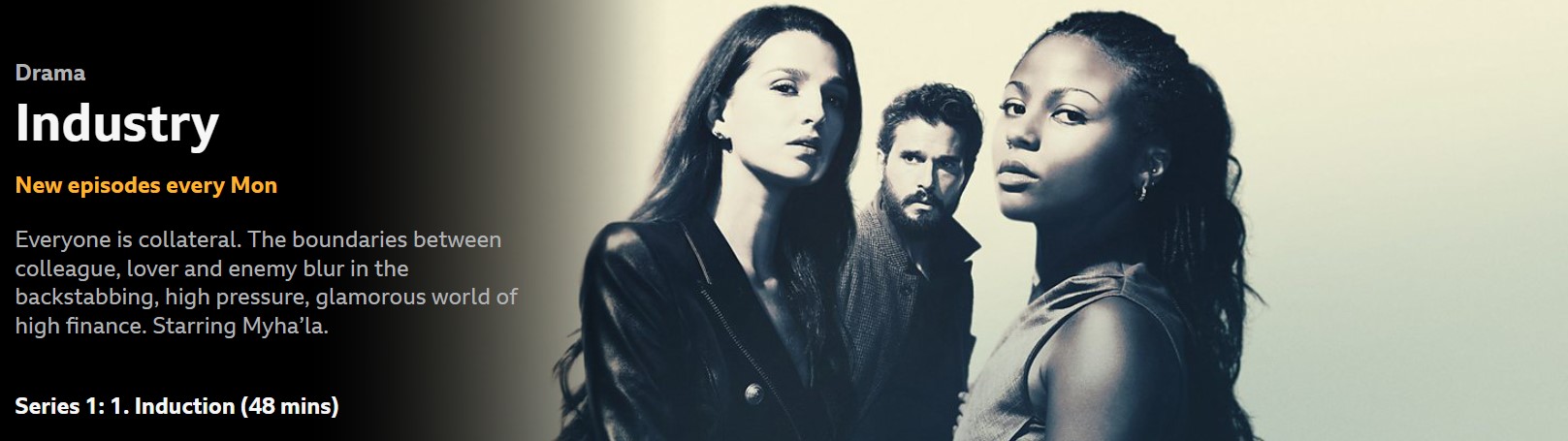
[Feature photograph from BBC i-player. All the series of the Industry programmes can seen on i-player, from here]