In this article RAY GOODSPEED looks at the first four issues of this paper, from 5-8 May. Part two (here) will look at issues produced in the second half of the strike, its end and afterwards
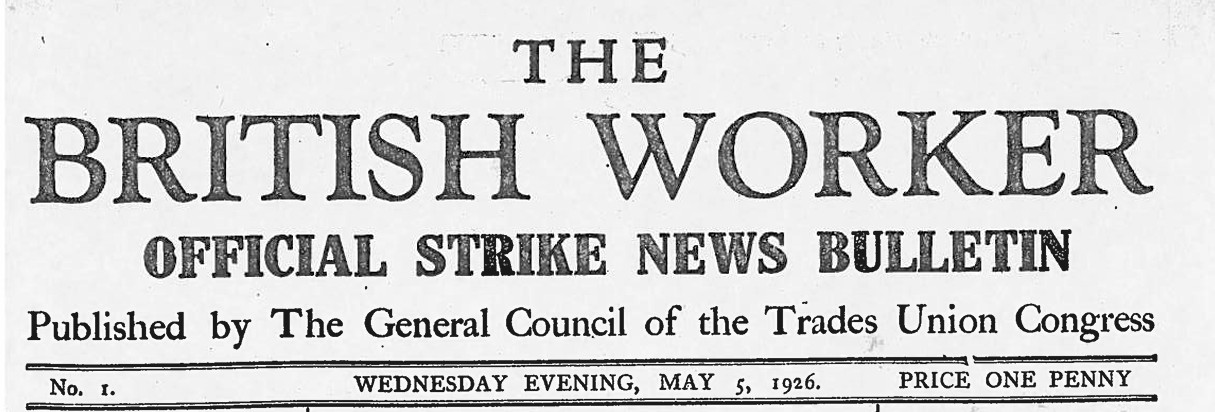
On 5 May 1926 the General Council of the Trades Union Congress produced the first issue of the patriotically-titled daily paper, British Worker (BW) – designed to build support for the general strike that started just before midnight on 3 May, and to answer the propaganda of the government newspaper – The British Gazette.
The print industry workers were called out on strike by the TUC, so the normal mainstream papers struggled to produce editions during the nine days of the strike. They also had the BBC radio, of course, but in 1926, few people had access to it. The British Gazette represented a determined effort by the Tory government to win the propaganda war and the TUC General Council were goaded into producing their own paper in response.
At 8 pm on 5 May, the paper was type-set and ready to go but was prevented by a large-scale police raid. The police had a warrant from the Tory Home Secretary, William Joynson-Hicks, 1st Viscount Brentford (widely known as “Jix”) to seize copies of the Daily Herald, a Labour-supporting paper that was produced from the same printworks, but they clearly wanted to stop the British Worker. A few sample papers were taken away and negotiations followed, involving senior Labour politicians. Eventually permission was granted. As the BW said on 6 May:
“The machines were started. Word was passed to the waiting crowd, who greeted it with cheer after cheer. And the police moved off as staff and crowd sang “The Red Flag”
“The crowd organised its own “police” who made an avenue for the cars to roll up, load and drive away among cheers.
“That was the final scene. It was the climax of a strenuous two days.”
In spite of all the technical and other difficulties, they achieved a print run of 320,000 copies, and produced an 8-page or 4-page paper every day of the strike, until it was called of by the General Council on 12 May. A few issues were printed after the strike to report on the “return to work”.
Enthusiastic reports of success
From the first issue the paper reflected a sharp contrast in its reporting. On one hand it was packed, page after page, day after day, with enthusiastic reports of the success of the strike and its completeness in terms of the very few numbers who were remaining in work or scabbing, but on the other it is crystal clear how uncomfortable the TUC leaders and the senior Labour Party politicians were with calling the strike at all and especially any suggestion that the strike was anything other than a purely industrial dispute over the wages and working hours of miners.
The paper was also very concerned to stress the peaceful and orderly nature of the strike and carried appeals to strikers to behave in that way every day.
The first issue (5 May) proudly announced that 2.5 to 3 million workers were on strike, and compared this to the estimated 30,000 volunteers that signed up for scabbing. Importantly, these workers were only those in the “first schedule.” Another tranche of workers were in a “second line of defence”, to be brought out on strike if need be.
On 6 May, it listed the sections of the workforce who had been called out on strike, naming unions in mining; railways; other transport; shipbuilding; engineering, founding and vehicle building; iron and steel trades; builders, woodworkers and furnishing; printing and paper; distribution (shop workers); public employees’ corporation workers; general labourers.
Three days into the strike, it said that workers were not “drifting back to work. On the contrary, the trouble everywhere is to keep those men at work who have not yet been ordered to strike.”
The paper poured scorn on the British Gazette, which it claimed was very hard to find. The other papers barely existed and even Hansard, the official record of the House of Commons, was not fully printed. The Gazette had apparently led with stories about how all the strikers were left-wingers and supporters of “extreme political opinions” and the BW was very keen to deny that.
It reported that in Parliament, senior Labour MP, J R Clynes:
“pointed out that the striking millions were not millions of Communists, but a mixture of Labour, Liberal and Conservative voters, most of them ex-servicemen who, having fought for their country, felt they were now entitled to fight for the miners.” (6 May)
Oxford students wrote that they were being pressured to join the strike-breaking volunteers, claiming that professors suggested that their participation would be “taken into consideration during exams”.
International solidarity
International solidarity was mentioned from as far away as Japan, as well as solidarity from French, Dutch, US, Canadian and Irish workers. Even German workers were “blacking” (refusing to handle) coal to the UK. This was only eight years after the savage and destructive Great War. The 8 May issue reports that there were no coal exports from French , Polish, Checko-Slovak (sic) and Mexican mines.
However, we can read that the General Council made an exception of one act of solidarity. A cheque from Russian Trade Unions was “returned with a courteous communication”!
Reports came in of how solid the strike was from all over the country. In a special feature (5 May) called “Solid in the North”. It included a report that
“the strike laid its paralysing hand on the great railway station at Carlisle, where seven important lines converge, forming a railway hub second to none in the country.”
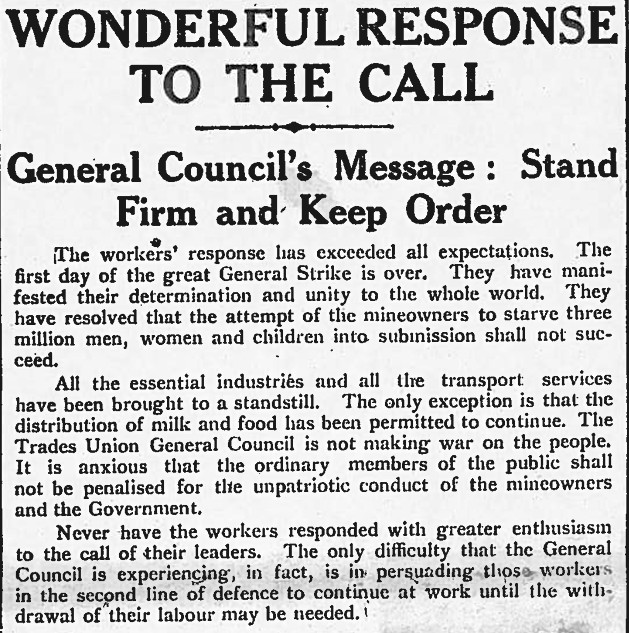
New sections of workers were being brought into action by the strike. Members of the Railway Clerks Association were experiencing their “first real baptism in a general withdrawal of labour”, but that their “spirit and morale” was “splendid” and they were “standing four-square” with other workers. Non-union members were signing up and joining in.
In Middlesborough, 30,000 steelmen were out as were 4,000 Cumberland miners plus 3,000 iron ore miners. The strikes in Hull and Newcastle were said to be complete, ie totally solid.
On 5 May it also reported that:
“The stoppage in Birmingham is complete. Not a man in the unions involved is working on railways, trams or other transport services.”
A report from London (7 May) said that 80 omnibuses were running, out of a fleet of 5,000, plus a few tube trains, but it said it “did not matter much whether or not people can get themselves carried about the West End of London”, when “what matters is that the great productive industries on which the whole national economy is based are shut down or shutting down.” Some passenger trains were running but no goods trains.
Peaceful demonstration of thousands
In Hull, the buses were suspended after a “peaceful demonstration of a crowd of some thousands. There was no violence. Mounted police are now patrolling the streets.” (7 May)
One report of a meeting in Swindon (5 May) captured the mood. Under the headline “Workers Fighting Crushing Methods of Capitalism” it quoted one speech:
“Either the capitalists are going to crush us or we are going to ensure for the miners a decent standard of living. With our backs to the wall we shall show that we can fight as Englishmen. If we are defeated in this struggle it will be the turn of the railwaymen next.”
On the 6 May it reported (under the headline “Easy Time for Police”) that “the whole East End of London is a great silent city, even quieter and more peaceful than on a Sunday. Not a workshop factory or commercial concern of any kind is doing business.”
On 8 May a report from the Woolwich Arsenal and Dockyard found that :
“No sound of a hammer breaks the stillness throughout the hundreds of shops and not a wheel is turning.”
8-10,000 were on strike and the Government-backed scabs in the “Organisation for Maintenance of Supplies” (OMS) had not been able to find the skilled workers nor anyone to carry out the “heavy manual tasks”.
Justice on our side
The Miners’ Federation issued a “manifesto” entitled “Justice is on our side”. Part of it reads:
“On behalf of the Miners’ Federation we express our heartfelt thanks for the magnificent loyalty with which you, our fellow workers, have responded to our appeal for aid.
“We have laboured for a peaceful settlement, but the Government, not only by its words, but by its actions, has shown only too plainly, that peace is not what it desires.
“In insisting that the miners should pledge themselves to accept a reduction in wages before even entering negotiations, it advanced an unheard of demand which no body of trade unionists could accept.
“In suddenly breaking off negotiations with the General Council and the Miners’ Federation on Sunday night it revealed its determination to force upon the Trade Union Movement a struggle for which the Government had long prepared.
“It is on the Government and the Government alone, that the responsibility for the present situation rests”
The BW included a table which set out clearly the enormity of the proposed wage cuts. In Northumberland, for example wages for “hewers” would be cut from 10 shillings and 4d, to 7 shillings and 7d. per day.
As a statement from the Mineworkers’ Federation said, reported in the BW (6 May):
“The results of the mineowners’ proposals would inevitably be that large numbers of our people would be in receipt of less money wages than those received in pre-war days. That is to say, a mineworker who was in receipt of, say, 35s a week in pre-war days would receive about 30s at the present time. A settlement with the mineowners on these lines would be impossible.”
The plight of women and children
On 6 May the paper also carried an article of the plight of the women of the mining community which outlined in moving terms the difficulties they faced and the extra “tragedy” that would be caused by the cut in wages:
“When there is talk of equal sacrifices by employers and employed, the human needs of the miner’s family are forgotten. Any reduction in the level of wages for them would mean falling below the hunger line.
“It would not be a case of going without luxuries, of taking bread instead of cakes; it would mean giving a hungry child one slice of bread instead of two, and water when it needs milk.
“Nor could a more prosperous time in the future make up for the privation of the present. To reduce the children’s food to-day means so to stunt their growth as to leave ill-effects for the rest of their lives.”
Propaganda war
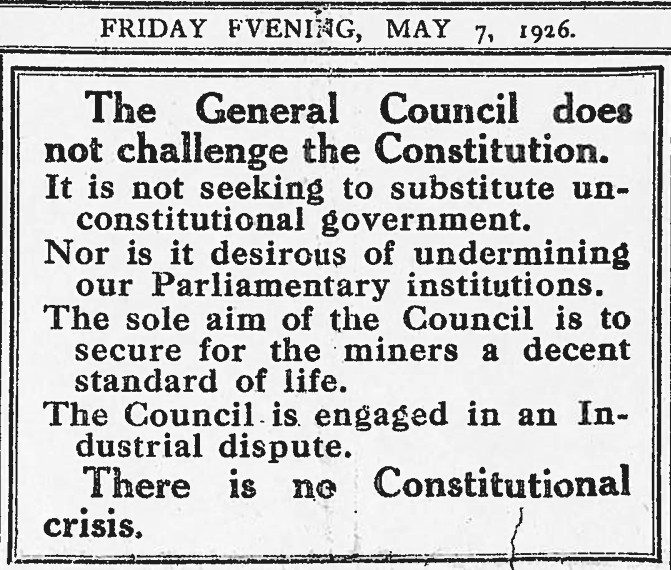
A constant propaganda war waged between the government and the TUC General Council, and reported in the paper, was the accusations that the general strike was illegal or that it challenged the constitution in some way, or was led by Communists or extremists. Of course, the leaders of the trade unions and of the Labour Party, dedicated as they were to constitutional forms and legality, were outraged at such suggestions, and the British Worker carried strenuous denials.
The paper complained (6 May) that Baldwin, the Tory Prime Minister had said: “The General Strike is a challenge to Parliament…constitutional government is being attacked”. The TUC response was indignant:
“That is untrue…no political issue has ever been mentioned or thought of in connection with it. It began over Wages and conditions of working; it has never been concerned with anything else.”
Tory ministers knew full well, of course, that the respectable men at the top of the unions and the Labour Party aimed at no such thing and reasoned, shrewdly, that even the threat that the strike may turn into a wider political struggle would put them under enormous pressure.
TUC desperate for negotiations
The Government were adamant that no negotiations could take place unless the strike was called off, while the TUC were desperate for negotiations to restart so that they could settle the dispute “peacefully,” and get themselves off the hook. They complained bitterly that there had been no need for the Government to break off negotiations before the strike was called.
Their excuse had been unofficial industrial action by printers at the Daily Mail, which led the Government negotiators to claim that the strike had started and cite interference with the freedom of the press. This was an obvious ruse. The government had prepared well in advance for a general strike and were ready for it. The TUC said that their negotiators did not even know about the Daily Mail incident, and that they were being treated unfairly.
The paper reported the view of the TUC General Council on 7 May:
“The position of the General Council may be stated in simple and unequivocal terms. They are ready at any moment to enter into preliminary discussions regarding the withdrawal of the lockout notices and the ending of the General Stoppage and the resumption of negotiations for an honourable settlement of the Mining Dispute. These preliminary discussions must be free from any condition.”
In response to accusation by the Home Secretary, “Jix”, that that the strikers were violating law and order, the paper replied (6 May) that the TUC had:
“urged every member taking part in the dispute to be exemplary in his conduct and not give any opportunity for police disturbances. The General Council had also asked pickets to avoid obstruction and to confine themselves strictly to their legitimate duties.”
Sir John Simon, a Liberal ex-minister, made a stinging speech in Parliament attacking the strike as an “attack on the community”, an “attempt to set up a rival government” which had “deprived the miners of a great deal of the sympathy they thoroughly deserved.” He claimed that as the stoppage was not in just one industry, the strikers had broken their contracts and hence were not protected by the Trades Disputes Act of 1906. He said that the union bosses could be sued “to the utmost farthing” for the damage to businesses. The TUC General Council furiously denied these charges in the BW (8 May).
But the strike was finely poised. On one hand its solidarity and effectiveness was going from strength to strength, with nothing happening in industry unless the General Council authorised it, but on the other, the leaders of the strike were being baited and terrified by accusations that they were plotting to challenge the government itself.
[All images from The British Worker from The British Worker – general strike newspaper, 1926 | libcom.org]