By Andy Ford
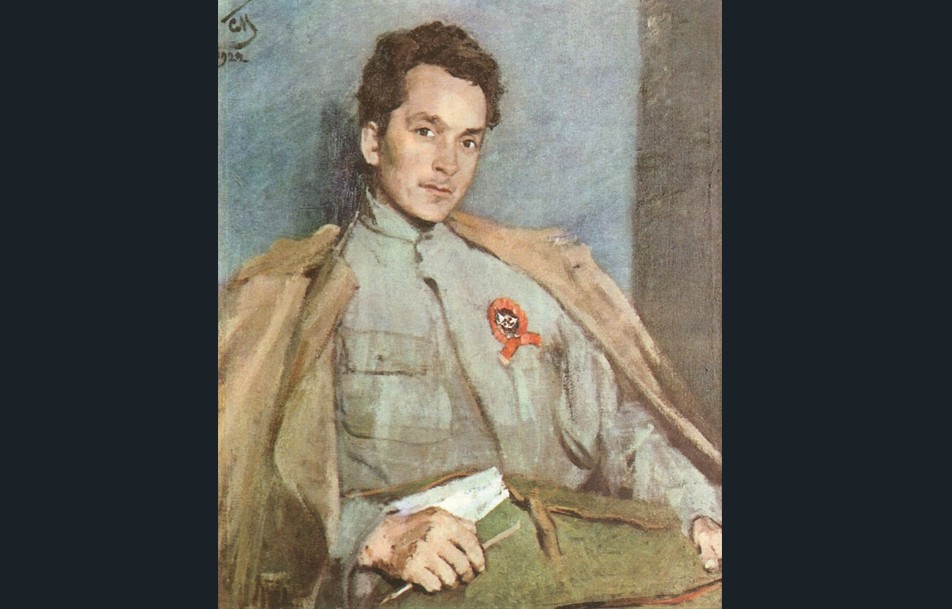
This year is the 100th anniversary of the death of the Soviet writer, Dmitri Furmanov, best known for his civil war novel, Chapayev (Чапаев 1923). Furmanov was a commissar attached to various Red Army detachments during the Russian Civil War and his diaries and notebooks were the sources for the three books he wrote before his untimely death in 1926 – The Raid (1921), Chapayev (1923), and The Mutiny (1925).
His best-known work, Chapayev, describes the adventures of a real Red Army cavalry unit in the years 1918-19 as they battle the White Army and Cossack units in the Ural region and the steppes of Kazakhstan. Based on first-hand experience, it makes a valuable contribution to an understanding of the Civil War.
Furmanov, thinly disguised as the commissar Klichkov, must keep Chapayev’s unruly band of guerilla fighters aligned with the strategy and tactics of the emerging Soviet state. The fighters are motivated as much by the desire for land and hatred of the Cossacks, who have exploited and oppressed them for generations, as by belief in a better, socialist world. The only way Klichkov, a total outsider, can influence these wild and rebellious peasants is by inspiring and advising their leader Chapayev, who has the undying loyalty of his men.
(photo – wiki commons]
The book is very good at showing how the only link between the elemental peasant revolts in the outlying Russian regions and the Soviet government in Moscow – and so to the urban working class and the revolution itself – is through one person: the commissar, Klichkov.
The novel begins in the textile district of Ivanovo-Vorozhensk, (the ‘Russian Manchester’), a Bolshevik stronghold and a centre of Soviet power. In fact, the city was the birthplace of the first Soviet of worker’s deputies in the whole Russian Revolution. The first chapter describes the embarkation of a thousand weavers who have enlisted in the Red Army onto the train that will take them 900 miles to the distant lands of the Urals, where the White army is threatening a breakthrough.
Anger and fear
On the journey, they hear of a factory town captured by the Whites, where hundreds of workers and their families were lined up and mown down by the White machine guns. The response is a mixture of anger and fear. They pass through Samara and arrive at Uralsk, (now in Kazakhstan), a city menaced by Cossack detachments in the surrounding country. The Red Army there is composed almost entirely of peasant regiments; the plan is that the working-class weavers can bring some structure and discipline to the revolutionary forces.
Chapayev and his cavalry arrive in Uralsk, which sits right on the border between Europe and Asia, where Commissar Klichkov meets his ‘partner’ and his fighters for the first time.
“Chapayev, though just off the road, refused to have tea. He talked standing, and sent an orderly to Staff Headquarters, where he, Chapayev, would follow. Soon the lads who had come with him burst into the room in a noisy crowd, they chucked their things into all corners; threw caps, gloves and belts onto the chairs, tables, window sills, they threw down their revolvers, while some unhooked hand grenades and carelessly threw them amongst the caps and gloves. Sun-burnt, stern masculine faces; deep gruff voices, crude movements and speech; they were cut awkwardly and carelessly, but with a strong confident hand”.
Chapayev’s unit is sent to take the Cossack village of Slominkhinskaya. The Red Army here was fighting not in the traditional Russian countryside but in the steppe zone where the Cossack lands formed a frontier between Russia and the native Central Asian peoples. Over the centuries, the Tsarist state had settled groups of Cossacks as free farmers with grants of land and tax exemptions, in return for military service.
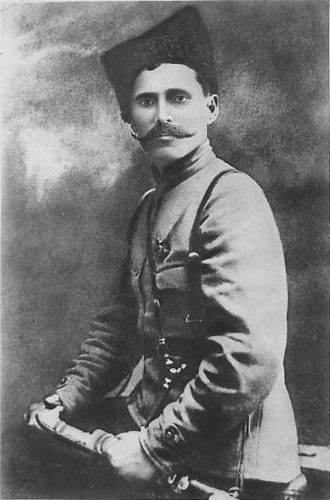
[photo – wiki commons]
The Cossacks were one of the very few groups of people who actually benefitted from Tsarism and fighting them in their native territory was a formidable task. Although Chapayev’s unit is victorious in their action, the Commissar, Klichkov, completely loses his nerve and flees to the rear, supposedly “looking for machine guns”.
“Drown the Russian revolution in blood’
Shortly after the battle, Chapayev’s unit is sent back towards Samara to help block the White Army of Admiral Kolchak in their bid to reach Moscow and drown the Russian revolution in blood. Kolchak was backed by the western allies with unlimited supplies of food, weapons, and munitions, in return for a promise to honour and pay all the debts of the Tsarist regime.
At the same time, the British Empire had landed a force of thousands in Murmansk in the Soviet Arctic, intending to attack the Soviet state from the north, and a French backed uprising under Denikin was trying to reach Moscow from Odessa on the Black Sea.
Nevertheless, the Red Army first blocked Kolchak at Buzuluk, leading to the mutiny of Kolchak’s crack regiment, the Taras Shevchenko, who went over to the Bolsheviks, and then advanced rapidly to the east. The book describes constant mutinies and defections of the White forces, who were mainly conscripted peasants who agreed with the Bolshevik programme. The book describes the way the Red Army approached the villages that they liberated from Kolchak, not only by paying for food and supplies, but also by recognising the fear of the villagers of a return of the Whites.
In one of the villages, Chapayev’s men find the bodies of Red Army prisoners tortured to death. Although the Commissar calls the men together and tells them that atrocities are futile, not one prisoner is brought in the next day, and Klichkov himself signs his first death sentence, for a White officer.
Chapayev and Klichkov participate in the liberation of Ufa, the defence of which was critical to defeating Kolchak. Every action of the battle for Ufa is described and explained and Furmanov gives a real first-hand documentary account of the Russian Civil War, using letters, newspaper articles and his own diary entries. When the White forces are driven out of Ufa, the Red Army go to the prison to see if the Whites have left anyone alive, and receive delegations from the Jewish community reporting the horrendous anti-Semitism they have endured under Kolchak’s forces.
Once Ufa is liberated, Chapayev’s division is sent back to Uralsk to lift the Cossack siege of the city. They arrive just in time, as its Red defenders are running low on food and ammunition. If they had been overrun, massacre awaited most of the inhabitants.
Chapayev – hero of the day
As they fight their way into Uralsk, they meet the peasants who have been enduring Tsarist occupation:
“In spite of the unceasing daily skirmishes with the Cossacks, the regiments made rapid progress covering 50 versts [A verst was just over a kilometre – AF] a day on foot. The Red soldiers were met as liberators in the peasant villages; the villagers received them hospitably, helped them in whatever way they could and shared their supplies with them.
Chapayev himself was universally accorded an especially warm welcome. He was “the hero of the day” in the full sense of the word.“Tell us just one thing friend” the peasants would beg him. “Will the Cossacks come again or have you driven them away for good?”
Chapeyev, pleased with himself and in a good humour, would give a knowing twist to his moustache, and answer good naturedly:“You get together and help us then they won’t come back. But if all you do is cling to the women’s skirts, then who’s going to protect you?”
“But what can we do?”
“Why the same as us”, Chapayev would answer, pointing to the Red Army men around him.
Then he would begin to explain to the peasants the source of the Red Army’s strength, how necessary it was to Soviet Russia, and what the attitude of the peasants should be towards it.
There were a dozen or so infallible and indisputable formulas which had stuck in Chapayev’s head. Some of them he had read somewhere, but for the greater part, he had picked them up in talks. For example, there was the formula about the class composition of our army; then the one to the effect that for the time being the majority of Cossacks were our enemies not by chance but inevitably; and the one about the necessity of immediately assisting the starving towns and cities from the abundant stores in the outlying regions, and so forth and so on. His clear, keen mind had grasped these simple, convincing formulas, and retained them once and for all, irrevocably. He was proud of knowing them and of remembering them, and was sure to try to bring them into the conversation, no matter whether they were relevant or not.”
Chapayev got particular pleasure out of elaborating these ideas in his talks with the peasants, who always listened to him with the greatest attention.”
When Uralsk is liberated, the citizens come out to meet Chapayev and his men with a brass band. Red flags are flown everywhere and revolutionary meetings convened throughout the streets.
Shocking final chapter
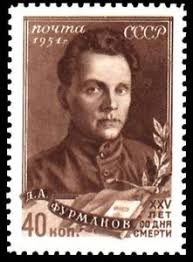
featuring Furmanov
[Image – wiki commons]
The novel does not end there: there is a shocking final chapter which cannot be described without ruining the book for any future reader, but suffice to say it’s not all ‘story book hero’ stuff.
Chapayev was hugely successful in the Soviet Union. Firstly, it is very well written, and very truthful. It could be considered one of the first works of ‘socialist realism’; that is, it is realistic, but puts forward a socialist perspective. Secondly it suited the emerging Stalinist bureaucracy to push a narrative of the raw working class and peasantry needing the instruction of a caste of professional functionaries.
Indeed, in 1934, the book was turned into a Soviet film under the personal supervision of Stalin, in which the slight political flaws were deepened and intensified. Chapayev is turned into a cartoon ‘story book hero’, his men are even wilder and more heroic, and Klichkov is even wiser and without defect. This was taken so far that the film spawned a whole genre of ‘Chapayev jokes’ as workers found a way to deflate the theatrics of the film.
But despite its flaws, Chapayev is an outstanding novel and historical document.
[Featured image – portrait of Furmanov by Sergey Malyutin – wikicommons]
Links:
1934 film ‘Chapayev’ dubbed (not very well) into English Chapaev
Lenin on the foreign-backed invasions of Soviet Russia in 1919 – The Present Situation and the Immediate Tasks of Soviet Power
Lenin on Antisemitism – Anti-Jewish Pogroms