By Sergio Sánchez Romero and Agustín Romero Clavero
On May 17, regional elections were held in the Spanish region of Andalucia, for the regional parliament composed of 109 deputies, with 6.5m eligible to vote. The right wing People’s Party (PP) and the far right Vox increased their representation and together gained over half of the total votes. The following article, from the Spanish Marxist website, Por el socialismo, describes the background and meaning of that election result.
Notes:
Por Andalucía is a left-wing electoral coalition in Andalucia. Led by Antonio Maíllo, the alliance brings together forces such as United Left (IU), Más País, Movimiento Sumar, Iniciativa del Pueblo Andaluz, Verdes Equo, and Alianza Verde [Green Alliance]
Adelante Andalucía is an Andalucian nationalist and regionalist political party founded by a former Podemos Andalucia leader
………………………………………………………………………………………………
The electoral result should be an incentive for Por Andalucía and Adelante Andalucía to draw conclusions, to abandon sectarianism, and to make a common front against the PP and Vox.
The president of the [regional government] Junta de Andalucía, Juan Manuel Moreno Bonilla of the PP, called the elections on the best date, May 17, to avoid a parade of senior officials of the Popular Party up in court for corruption in Almeria.
Andalucia is the most populous region in the Spanish State and, for Bonilla, it provides a platform for his very important presence and power in the national state PP apparatus. In addition, using polls managed by public funds, the election serves as a facelift to counteract his shame and responsibility in the scandal and, at the same time, to pressure the Sánchez government in Madrid, in the event that the results were favourable to him, as has been the case.
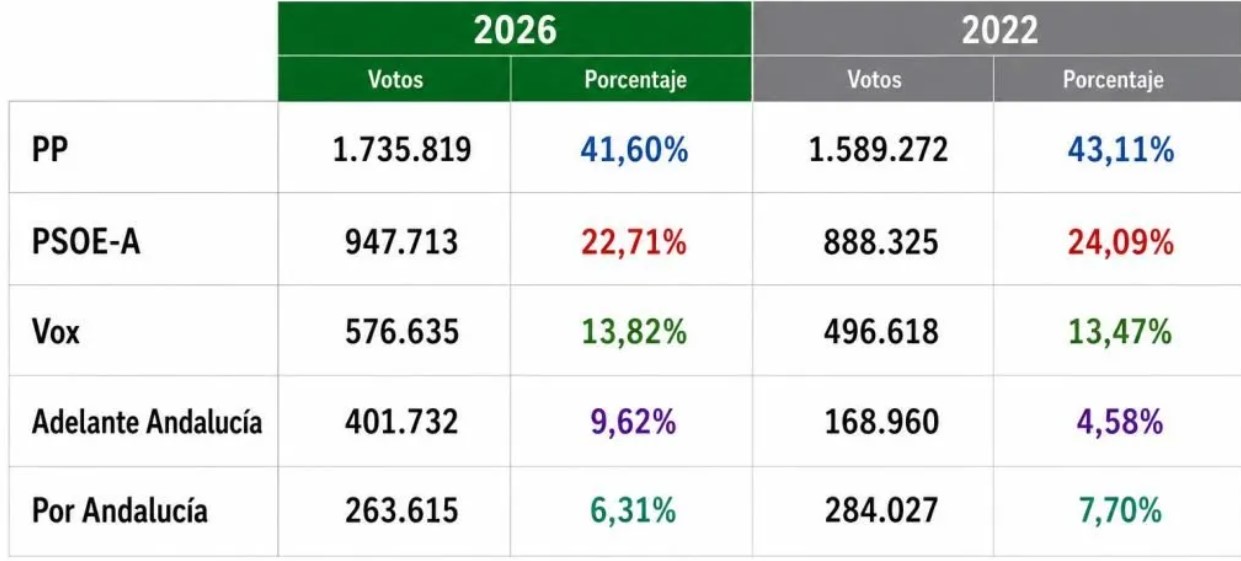
The PP has had an undisputed triumph, winning 53 seats, with 1,735,819 votes (41.60%). In contrast, the candidate of [the Spanish Socialist Party in Andalucia] PSOE-A – María Jesús Montero, who is the vice-president of the central government – led it to 947,713 votes and its lowest-ever percentage (22.71%).
Results consolidated PP’s power
These results have helped the PP’s Bonilla consolidate his power and, the very next day, to call for national elections, not due until 2027. Bonilla had set himself the goal of obtaining an absolute majority in the regional parliament, so as not to depend on Vox. In this, however, he has not succeeded, losing 5 seats, two short of an absolute majority of 55.
Bonilla has opened the door to and made a pact with Vox, whitewashing its role in various organisations, only to be expected when PP and Vox defend the same interests: on the one hand, those of businessmen, bankers and private health multinationals; and on the other, those of Andalucian landowners.
In fact, Bonilla brought the elections forward by a month to avoid the effect of the heat, since in the previous elections, held in June, many voters were left unable to vote due to traffic jams on their return from the beach.
Part of a national political trend
The results of the elections in Andalucia are part of same trend taking place at national level; they repeat of the results that the PP and Vox have achieved in the elections in other autonomous regions, like Extremadura, Aragon and Castilla y León. In these regions, the reactionary pacts of the right and the far right were consolidated because of the poor results of the PSOE and the alternative left, without a programme and credible candidates that would overcome the disaffection of the voters who in the past voted for the left.
Of the 10 poorest neighbourhoods in Spain, 7 are in Andalucia. The success of the PP/Vox demagoguery means that the left will have to go through a period of ‘crossing the desert’; and it needs also to change its strategy to reach the working class with policies to improve of the conditions of workers. As it is, the wealth generated by the working class – the profits of banks and large fortunes – continue to grow, while poverty among working families continues to increase.
The left needs to rethink its attitude towards the government and its ministries and institutions. With the results in Andalucia those opposed to the left, PP and Vox, have already have half a campaign ready for the next municipal and general elections.
For the left, the same mistakes were made in Andalucia as had been made in the past. Right up to the last minute it was not known how many candidates were going to be presented. Fortunately, the example of the results from Extremadura weighed more heavily among the leaders of Podemos and IU [Left Unity] than those of Aragon and Castilla y León.
In Extremadura, the alternative left to the PSOE saved the day by running together joint candidates of Podemos, IU and Alianza Verde, and obtained reasonable results. However, they competed separately in Aragon and Castile and León, and failed.
An alternative programme
We cannot escape the fact that left-leaning voters are more responsive when they are presented with an alternative and a programme; when solutions and are posed to the problems that affect the working classes as a whole. This is the most significant factor that mobilises the people in the neighbourhoods and towns to vote left.
But it is the lack of an alternative credible programme that causes the current situation. Andalucia saw large-scale abstentions, and unfortunately, the right-wing bloc of PP/Vox, is now consolidated in the working-class neighbourhoods.
We fear that, after this Andalucia result, that there will be a return to the old ways of division and sectarianism. There needs to be instead a rigorous analysis of how Vox, with 0 mayoralties and 8 council seats – 5 of them in Cádiz – has been able to go from 2 to 8 seats in the Andalucian Parliament.
Adelante Andalucía [Forward Analucia, a regional party] quadrupled its vote from previous elections, gaining 401,732 votes, or more than 9%. If they had run in a joint candidates with the left, the entire left would have surpassed Vox by more than 90,000 votes, relegating it to fourth position not only in Cádiz and Seville, but in all of Andalusia. And all this without taking into account the effect of unity as a unifying and mobilising factor of the vote.
The social atmosphere was there, as reflected in the polls, but the leaders clung to the usual policy: to change the system by being part of the government and to criticise the government while in the government itself . Or to insist for the umpteenth time that problems are solved through parliament instead by fighting in the streets the communities.
Adelante Andalucia has galvanised support
An organisation even without roots in the whole of Andalucia, Adelante Andalucía, has shown the way, by becoming a vehicle for the aspirations of thousands of young people: those without housing in large cities and with precarious jobs. It has also become a benchmark for working class families dissatisfied with the policies of PSOE, which is increasingly less interested in the working class and closer to the large electricity companies making great fortunes.
Working families perceive that the supposed “most progressive government in history” is not doing enough to combat the price rises of basic necessities. As well as this, workers’ families and women in particular are affected by the poor quality of public health. Adelante Andalucía has been, during the four years of this parliament, a loudspeaker for so many exploited rural workers in hundreds of Andalucian villages, who have had no voice.
Both Por Andalucía and Adelante Andalucía, should draw the necessary conclusions and turn their backs on sectarian brawls, and to make a common front against the right and Vox. If we do not want to see an overwhelming triumph of the PP and Vox in the next municipal and general elections, it is necessary to change the dynamic among the affiliates and sympathisers of the entire left, in order to stop the right.
Sergio Sánchez Romero, is a councillor for Left Unity in Bollullos de la Mitación and Agustín Romero Clavero is a Left Unity militant in Pino Montano Sevilla
This is an edited version of an article from Por el socialismo and the original can be found here.