By Cain O’Mahony
On September 11, on the 25th anniversary of the attack on the Twin Towers and other targets in the USA, we carried the first of two articles on what led up to those events. That article, the ‘road to 9/11’ is here. In his second article, Cain O’Mahoney looks at the aftermath.
………………………………………………………….
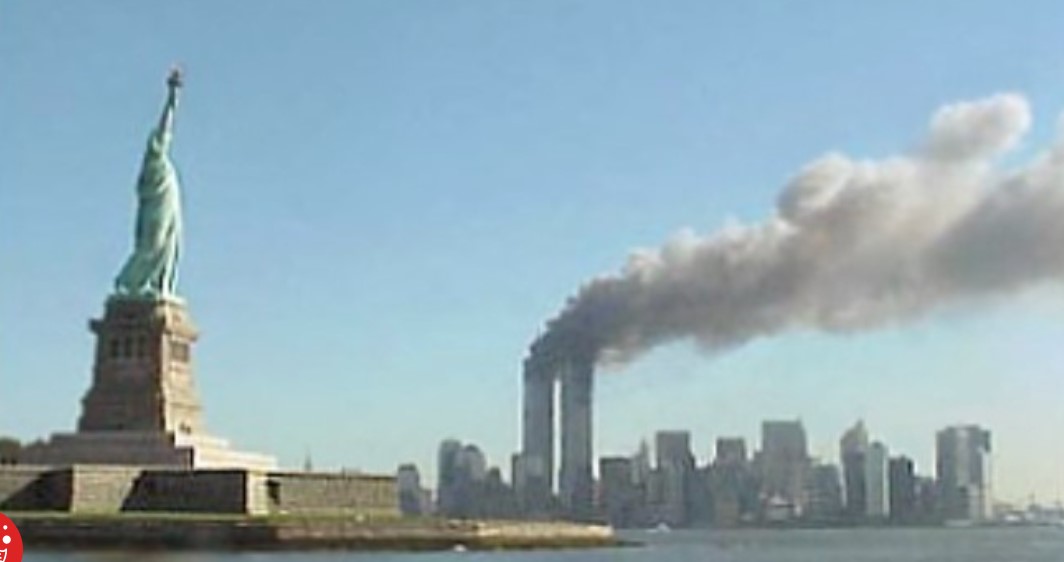
While bodies were still being recovered from the smouldering ruins of the buildings destroyed on 9/11, US imperialism had already decided to carry out the most cynical ‘false flag’ operation in history.
Bruce Riedel was on the staff of the US National Security Council with President George W Bush in the White House during the attacks. “On September 14” he recalled, “I was with Bush when he had his first phone call after 9/11 with British PM Tony Blair. Bush immediately said he was planning to ‘hit’ Iraq soon. Blair was audibly taken aback. He pressed Bush for evidence of Iraq’s connection to the 9/11 attack and to Al Qaida. Of course, there was none, which British Intelligence knew” (Bruce Riedel, 9/11 and Iraq: the making of a tragedy, Brookings, September 2021).
This showed the true face of US imperialism: they would exploit the shock, grief and anger of their people after 9/11 as a cover for a long held strategy to gain control of the massive untapped oil reserves in Iraq. As one commentator called it, it was “… the biggest oil grab in modern history” (MT Klare, Oiling the Wheels of War, The Nation, 2002).
Dependent on Middle East oil
In 2001, the USA was still heavily dependent on oil from the Middle East (unlike today, where they are largely self-sufficient and most of their oil imports are from Canada – hence Trump’s determination to make Canada the ‘51st State’). Iraq harboured one of the world’s largest reservoirs of untapped oil, while Saddam Hussein’s nationalisation of their oil industry kept out the fossil fuel multinationals from the possibility of vast profits.
In the period before 9/11, US capitalism was infuriated that Saddam Hussein looked set to provide contracts to Russia, China and some European countries to exploit these reserves. The US envisaged installing a pro-US government that would void the contracts and award them to US companies.
To achieve this, US imperialism had a new term in its lexicon: ‘regime change’. With the fall of the Soviet Union, US imperialism was riding a wave of triumphalism, and felt it was unhindered globally. Even those involved in national security later recognised this, with one commenting,
“Under this grand strategy, the US sought to spread liberal democracy and capitalism, which…were ways to maintain global dominance. The Cold War had restrained this strategy, but the Soviet collapse allowed the US to pursue it with reckless idealism and hubris” (Joseph Strieb, Why did the US invade Iraq, Texas National Security Review, vol 6. Issue 3, Summer 2023).
They had been bolstered in their new belief in ‘regime change’ three years earlier in the Kosovo War, where – with the Kosovan rebels providing much of the ground troops – they had effectively brought down the Serbian regime with a massive bombing campaign from the air. If it worked in the Balkans, why not Iraq?
Iraq had no involvement in the 9/11 attack
And now they had a ‘sort of’ peg to hang it on. There was of course absolutely no involvement by Iraq in the Al Qaida attacks of 9/11. Saddam Hussein’s regime was diametrically opposed to Islamic fundamentalism (and vice versa). He had seen at close hand the toppling of the Shah dictatorship in Iran, and, politically closer to home, the overthrow of a leftist regime in Afghanistan by fundamentalists.
To justify the proposed war, the US government and its intelligence agencies whipped up a storm of fake intelligence that Saddam Hussein was stock-piling ‘Weapons of Mass Destruction’ that could be unleashed on the West at any given moment. When pressed, the only ‘evidence’ they could provide was based on questionable reports by Iraqi dissidents (to which saner people said ‘well, they would say that wouldn’t they’).
For good measure Al Qaida, the Iranian Islamic Republic and Iraq were all lumped together in, to quote George Bush , an “axis of evil”. It was all ‘just one enemy’.
There is no question that the Saddam Hussein regime was up there with the nastiest dictatorships in history. It had suppressed any and every outbreak of dissent in the most brutal fashion, and was not averse to using poison gas against recalcitrant populations.
But its sudden demonisation by US and Western imperialism was just so much rank hypocrisy. Like the foundations of Al Qaida in Afghanistan which the West had funded, so too had they had poured money and weapons into Iraq when it suited their global objectives.
After the Iranian revolution, Saddam was pushed by the US to launch a war on the new Iran in 1980, and for that war, the US provided Saddam Hussein with over $1.5 billion’s worth of weapons, as well as providing reconnaissance intelligence to Iraq.
And the regime certainly had chemical weapons – because the West provided them. The US gave the go-ahead for companies from the US, UK, West Germany, the Netherlands and France to provide raw materials and assistance in developing chemical weapons. These were used with devastating effect in the brutal Iran-Iraq War, which left over one million dead.
Blair used dodgy intelligence to justify the unjustifiable
But now US and Western imperialism was telling a shocked populace of this ‘new’ WMD threat, all to justify what they believed would be a quick ‘regime change’ exercise.
In the UK, Blair may have been ‘taken aback’ by George Bush’s insistence that Iraq was to blame, but the central plank of Labour’s right wing has always been a slavish subservience to US imperialism, at any price. So within days, Blair was ‘with the programme’ and his PR sidekick Alaistair Campbell was scuttling around the editorial offices of the right wing media peddling the ‘dodgy dossier’. Soon headlines were screaming that Iraq could attack the UK with WMD at just ’45 minutes notice’.
Anyone who dared to question this nonsense felt the full blast of the establishment. The journalist Andrew Gillighan who dared to suggest Blair’s ‘evidence’ had been ‘sexed up’ was hounded out of the BBC. The whistle blower Dr David Kelly – one of the world’s most respected experts on chemical weapons who challenged the fake intelligence – was found dead in a wood.
The Blair government did hold an inquiry into Kelly’s mysterious death and its chair, Lord Hutton, ruled it was definitely suicide. But then he compounded the generalised suspicions around Kelly’s death by ruling that all the evidence submitted to the enquiry would have to be kept secret for 70 years!
In the US, because of the grief and anger over 9/11, opposition to the call for war on Iraq was muted. Not so in Europe, and the UK in particular. The spin of the Blair government fooled no one, and on February 15, 2003 anywhere between 1 – 2 million took to the streets of London to say ‘No!’, in the biggest single protest in UK history.
Blair clung onto George Brown’s coat-tails
Blair, of course, did not listen, and – hanging onto US imperialism’s coat-tails – together blundered into what are now termed the ‘Post 9/11 Wars’ in the Middle East, which are still rumbling on and so far – probably a conservative estimate – has left 940,000 dead, massive destruction and yet millions more refugees. The only thing US imperialism achieved was ISIS and the Islamic State, total capitulation in Afghanistan and an upsurge in global terrorism. Neither did they ever find any WMD.
In both the USA, the UK and elsewhere, new laws were put on the stature book immediately after 9/11, to strengthen the oppressive armoury of the state, in terms of surveillance and intelligence gathering. In the USA there was the Patriot Act and in the UK, the Anti-Terrorism, Crime and Security Act, both of them measurably strengthening police powers. These laws, supposedly put in place to combat ‘terrorism’, have since been used to suppress legitimate protest movements that have nothing to do with what one would consider terrorism.
25 years on, in terms of its global policies, it is clear that US imperialism has learned nothing. Despite promises on the election trail to end ‘Forever Wars’ – especially in the Middle East – the Trump administration once again somehow convinced itself that ‘regime change’, having worked apparently in Venezuela, would now work in Iran. They thought that after the mass protests against the Iranian regime, a few well placed bombs would see the Iranian clerics topple (and the US would get control of the Straits of Hormuz). Instead, the next hornets’ nest has been kicked over, and a new Forever War begins…and is now six months old.
What Bush and Trump fail to understand is that regime change can only come from within, from the mass of the people themselves. Attempts to impose it from on high – especially when it is the hated US imperialism – can only increase ‘national unity’ against a perceived foreign enemy. This is true, no matter how much Iranian workers and youths were opposed to the regime previously. Iranians will not accept their ‘liberation’, from imperialist bombs falling on their heads.
Lenin once warned that unless capitalism and imperialism were overturned internationally, human kind would forever face “horror without end”. Nowhere is that more true than the Middle East today. In that sense, 9/11 was a key milestone in modern world history, delineating the end of any pretence of international ‘law’ and collaboration, and ushering in a period of naked, unadorned imperialist plunder and aggression.
These are characteristics of our times – an epoch of wars, revolutions and counter-revolutions; and unless and until there are mass movements around the world that bring capitalism to its end, then wars and upheavals will only grow in frequency, intensity and ferocity.