Andy Ford continues his series of articles on the 80-year anniversary of the Chinese Revolution.
Over the course of autumn 1946, Chiang Kai-Shek continued his ‘general offensive’ against areas held by the Chinese Communist Party guerillas, organised in their emerging army, the People’s Liberation Army (PLA). Although his forces held a numerical superiority and were well armed (courtesy of the American taxpayer) they did not win the expected knockout blows against the PLA, who deployed superior tactics, had better morale, and enjoyed mass support in the countryside.
One of the best examples was the Central Jiangsu campaign, where 30,000 PLA guerillas defeated a much larger force of 120,000 nationalist Kuo-Min Tang (KMT) troops sent by Chiang Kai Shek to surround and exterminate them.
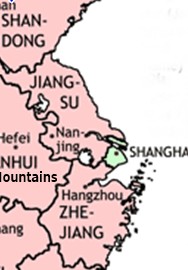
As the KMT troops began to assemble, Mao wanted to evacuate the region to conserve the communist forces. However, the local commander, Su Yu, strongly believed his soldiers could defeat the KMT. Su Yu was quite a remarkable figure. He had stayed behind in central China when Mao and the bulk of the communist army moved north in the ‘Long March’ of 1934. In the years that followed he built the scattered guerilla units into an army – the New Fourth Army – in the province of Zhejiang, south of Shanghai. When the war with Japan started in earnest in 1938, he expanded operations into the coastal province of Jiangsu.
His argument to Mao against abandoning the liberated areas of Jiangsu in 1946 was threefold: firstly, the human and logistical cost of leaving millions of peasant supporters to face the wrath of the KMT and the landlords; secondly, the fact that, as the KMT expanded to occupy the area, their forces would become over-extended and vulnerable; and thirdly that the landscape of Jiangsu, with its canals and muddy rice paddies would render the KMTs American-supplied vehicles more or less useless. Mao eventually relented, and gave Su Yu a short window of time to prove his ideas. The result was a series of stunning victories, known to Chinese history as “Seven Battles, Seven Victories”.
Surprise attack
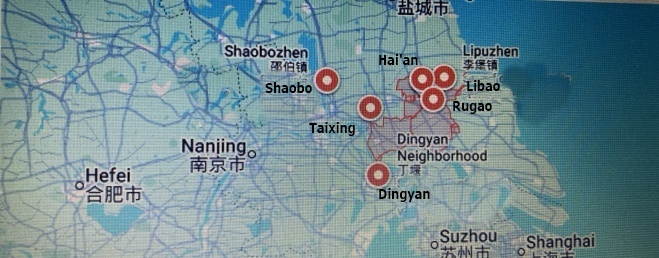
At Taixing, in mid-July 1946 the New Fourth Army launched a surprise attack on newly-arrived KMT units as they complacently prepared for a long siege. 3,000 KMT troops were wiped out and Su Yu now had the initiative. The next week, at Riugao, Su’s troops bypassed the nationalist front line and suddenly appeared in their rear, inflicting 10,000 casualties. Two weeks later, at Hai’an, the PLA defended against a KMT attack for 4 days, causing heavy casualties, and then made an orderly retreat. Then, at Libao in mid-August the PLA ambushed and destroyed the nationalist brigade pursuing them after the retreat from Hai’an.
At the end of August Su Yu suddenly appeared at Dingyan, on the opposite side of the liberated zone of Jiangsu and attacked isolated KMT outposts on a main highway, removing one of the fronts intended to surround the PLA. Shortly afterwards, at Shaobo, the PLA repelled a frontal KMT attack across the Grand Canal, preserving the liberated zone. Finally, at the Battle of Ruxi, the Communists encircled and destroyed two KMT brigades sent to rescue a besieged outpost. The KMT had to retire, defeated, leaving the Communists in charge of central Jiangsu – 30,000 communists under Su Yu had defeated a nationalist force of 120,000.
In his Memoirs Su Yu explained and systematised his ideas for successful guerilla war. He argued for localised superiority – by moving at ease within the liberated area, Su could concentrate his forces to achieve a local 3 to 1 or 4 to 1 advantage to overwhelm and annihilate a single KMT unit. He always avoided fortifications and entrenched positions, waiting until the KMT units were on the move, where he could ambush them. He would avoid the best equipped and experienced KMT divisions, leaving them to go trekking off into the rural hinterland, and then attack the weaker troops following. The PLA soldiers would use local knowledge and local support to move at night through country back roads to appear unexpectedly in the rear of the besieging troops, wreaking havoc on their logistical support and reserves.
In his book he set some general principles: that military tactics should adapt to Chinese conditions and local terrain; that popular support is essential; that the art of war is learnt through practice, not theory; that failures must be studied honestly; and most importantly, to concentrate force to destroy the enemy.
In Chinese communist articles, like those by Mao and others, the PLA strategy is often described as “fighting on interior lines”; one way to understand it is to see the communist forces as a fist moving around inside their territory, dealing blows to the nationalist armies outside. Meanwhile the nationalist armies are like tentacles probing into the territory, attempting to catch and strangle the fist.
The Jiangsu campaign had significant effects. The nationalists were stalled in their ‘general offensive’ which aimed to suppress and pacify the communist liberated zones in central and north China, before moving to retake Manchuria to the north. But also, it was a huge morale boost to the communists, and a massive blow to the KMT nationalists. From that point on, Mao began to consider whether his formerly rag-tag guerilla force could defeat the American armed KMT divisions in open battle.
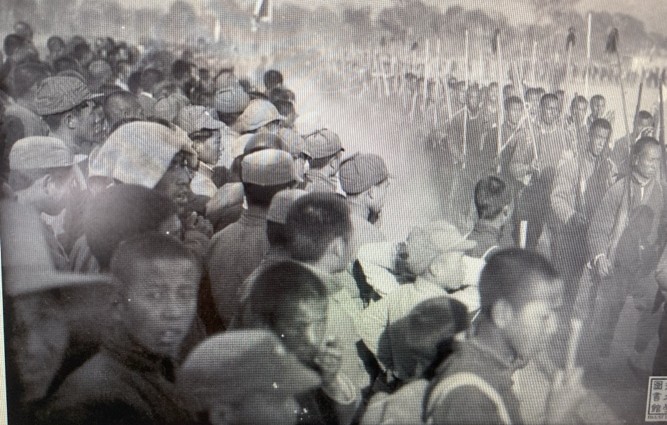
[Featured photo – peasants armed by the CCP – photo by Sha Fei and the Hong Kong University of Science and Technology]