By Greg Oxley
To mark the one hundred and tenth anniversary of the Easter Rising in Dublin 1916 we are publishing a political biography of James Connolly. Remembered today mainly for his leading role in the Rising, Connolly was in his time a significant figure on the Left in Britain, the USA and internationally.
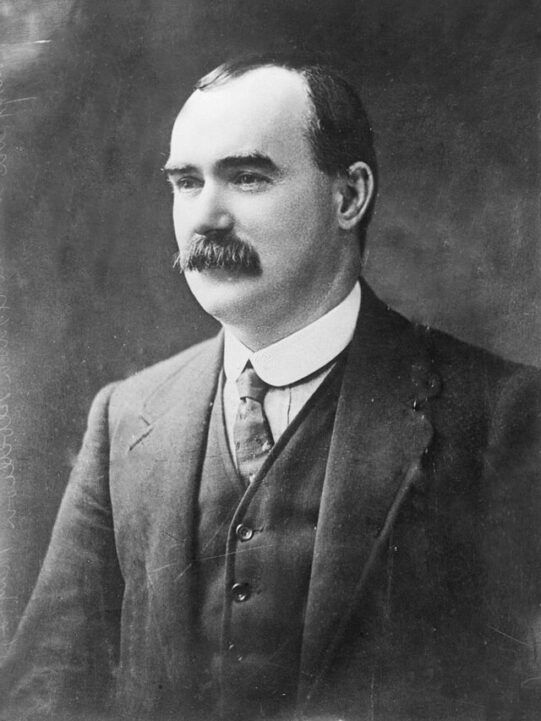
The revolutionary and internationalist James Connolly was one of the leaders of the Easter Rising in Ireland in 1916. Seriously wounded during the fighting, he was executed in Kilmainham Prison on 12th May, tied to a chair in front of a firing squad. Connolly said that revolutionaries were despised during their lifetime and adulated after their death. Today, Irish “folklore” showers him with praise. His portrait appears on the cups and ashtrays sold to tourists. In the street, people pass in front of statues erected in his honour and politicians use refer to him in their speeches. However, the ideas and principles that guided James Connolly throughout his life are not very well known and are often distorted to empty them of their revolutionary substance.
James Connolly was born in Edinburgh, Scotland, in 1868. At the time of his birth, his father, a migrant of Irish origin, was a carter, transporting loads of manure. Young James’s very first struggle was against poverty in the family home. At the age of 11, he was illegally hired on the printing press of the Evening News, until the day a labour inspector discovered his age. Moving from one job to another and with no other solution in sight, he eventually enlisted in the 1st battalion of the Kings Liverpool Regiment. Considered to be too “Irish” and unreliable, the regiment was disarmed several times during riots and popular uprisings, for fear that its men would go over to the side of the insurgents. It was probably during his time in this regiment that the young Connolly (he was only 14 years old at the time of his enlistment) began to forge his political convictions. He saw his father’s homeland for the first time when his battalion was sent to Ireland in 1882. The mission ended two years later, and his battalion was sent back to England. At the same time, his father suddenly lost his job due to an accident and would later become a public toilet supervisor, but not before his worried son abandoned the army. The fortuitous loss of the regimental registers saved him from being arrested for desertion.
Start of his political journey
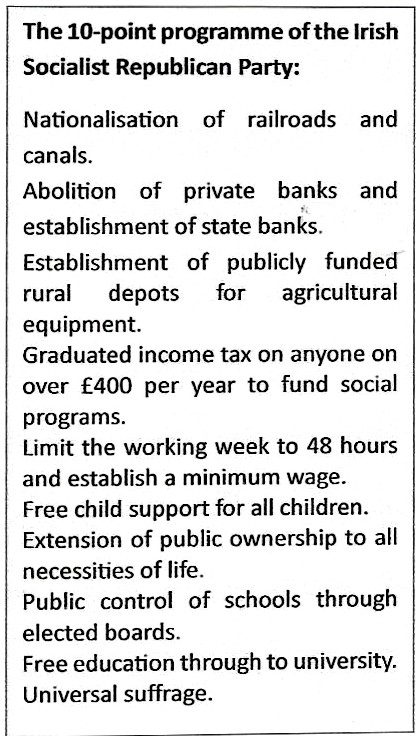
Connolly joined the Scottish Socialist Federation, of which his older brother was secretary, and became familiar with the basic ideas of socialism. He wrote articles for Justice, the Marxist newspaper of the Social Democratic Federation. Finally, in 1896, now married and with three daughters to feed, he returned to Ireland as an organiser of the Dublin Socialist Club, whose paper bore the same the subtitle of the journal Révolutions de Paris, published during the French Revolution: “The great only appear great because we are on our knees. Let us rise!” As soon as he arrived in Dublin, Connolly founded the Irish Socialist Republican Party (IRSP) and published a ten-point programme that included the expropriation of the capitalists and the transfer of land and the means of production, distribution and exchange into public ownership. Agriculture would become “a public service, administered by management committees elected by farmers and accountable to them and to the nation.”
Throwing himself wholeheartedly into political activity, Connolly was dogged by financial hardship. The family lived in one room. His meagre salary as a “full-timer” was paid irregularly, forcing him to work at the same time in the shipyards or as a proofreader. When there was no work, the family mortgaged their few possessions, and Connolly went to the library to read or write articles. He attacked the English socialists who refused to support the struggle for Irish independence, on the pretext that it fuelled “national rivalries”.
In 1897, the poor potato harvest once again threatened the Irish people with starvation. In a text entitled The Right to Life and the Rights of Property, Connolly called for revolt: “… in 1847 our people died in thousands of starvation, although every ship leaving an Irish port was laden with food in abundance. The Irish people in that awful year might have seized this food, cattle, corn, and all manner of provisions, before it reached the seaports, prevented the famine and saved their country from ruin, but did not do so, believing such action to be sinful, and dreading to peril their souls to save their bodies.”
Connolly wanted to start his own newspaper to better build the IRSP, but he had no money. When he went to Scotland in the hope of finding the necessary funds, James Kier Hardie, who was to become the first leader of the Labour Party founded by the British trade unions in 1900, gave him £50. In August 1898 Connolly was able to print the first issue of Workers’ Republic. Connolly’s reputation as an orator and theoretician of socialism was growing. He bought a small press to print the newspaper, for which he was at the same time editor, writer, typographer, proofreader and printer.
The IRSP led a vigorous campaign against the Boer War in South Africa, which resulted in Connolly’s arrest for the second time (the first had been for organising a protest against Queen Victoria’s Jubilee). The police did not lock him up for long, but when he went to the little office of the Workers‘ Republic, he found that the press had been destroyed. Nevertheless, the IRSP’s campaign against the war was a clear success. Army recruiters could hardly find any volunteers in Dublin to go to war in Africa.
Affiliated to the Socialist International, the IRSP clearly stood in the revolutionary wing of European social democracy. At the Congress of the International in 1900, its delegates were part of the minority opposition to “Millerandism” in France. The socialist Millerand had participated in the same government as General Galliffet, the butcher of the 1871 Paris Commune, under the pretext of wanting to “influence” government policy.
Socialism and Religion
One of James Connolly’s greatest contributions to the theoretical legacy of Marxism is the way he approached the question of religion from a socialist perspective. It must be borne in mind that in those times the Catholic Church had a very strong hold on virtually every aspect of social, political and moral life of Ireland, so that a propagandist who attacked religious doctrine or the Church head-on would only create a wall between socialism and the people. Connolly did not spare the religious authorities. In his texts and speeches, he shows how, time and time again in history, they supported and encouraged oppressors of the Irish people, threatening those who resisted with excommunication and death. At the same time, Connolly held that early Christianity and many theologians and saints had defended communistic ideas and principles, castigating private property and exploitation. In a very skilful way, he contrasted the communistic traditions of early Christianity with the degenerate morality and behaviour of the religious authorities. He did not ask Catholics to renounce their religion but strove to convince them that their beliefs should not prevent them from engaging in the struggle for socialism.
Here, for example, is an excerpt from his book Labour, Nationality, and Religion, written in 1910 in response to a propaganda campaign orchestrated by the Catholic Church in Ireland with the aim of presenting the ideas of socialism as an emanation of the devil: “The Socialist doctrine teaches that all men are brothers, that the same red blood of a common humanity flows in the veins of all races, creeds, colours and nations, that the interests of labour are everywhere identical, and that wars are an abomination. Is not this also good Catholic doctrine – the doctrine of a Church which prides itself upon being universal or Catholic? How, then, can that doctrine which is high and holy in theory on the lips of a Catholic become a hissing and a blasphemy when practised by the Socialist? The Socialist does not cease to love his country when he tries to make that country the common property of its people; he rather shows a greater love of country than is shown by those who wish to perpetuate a system which makes the great majority of the people of a country exiles and outcasts, living by sufferance of capitalists and landlords in their native land.”
The National Question
Connolly’s name has been dishonestly “co-opted” by nationalist politicians in Ireland. Even the IRA claimed him as one of their own, while it massacred workers whose only “crime” was to be Protestants. But Connolly was against sectarianism and bigotry and was not a nationalist. He was, on the contrary, an implacable internationalist. Of course, he wanted to liberate Ireland from British imperialist control, but he saw this struggle as inseparable from the struggle for socialism. He rejected the argument advanced by some nationalists that socialism could only be a “later stage” and should not be considered as an immediate task. Lenin and Trotsky knew and appreciated Connolly’s writings and positions on this issue. Indeed, Connolly’s approach coincided with Lenin’s approach to the nationalities oppressed under the tsarist regime.
This excerpt from an article in the Workers‘ Republic newspaper in 1899 shows how Connolly mercilessly derided the politics of the nationalists:
“Let us free Ireland! The rack-renting landlord; is he not also an Irishman, and wherefore should we hate him? Nay, let us not speak harshly of our brother – yea, even when he raises our rent. Let us free Ireland! The profit-grinding capitalist, who robs us of three-fourths of the fruits of our labour, who sucks the very marrow of our bones when we are young, and then throws us out in the street, like a worn-out tool when we are grown prematurely old in his service, is he not an Irishman, and mayhap a patriot, and wherefore should we think harshly of him?
“Let us free Ireland! The land that bred and bore us! And the landlord who makes us pay for permission to live upon it. Whoop it up for liberty! Let us free Ireland, says the patriot who won’t touch Socialism. Let us all join together and crush the brutal Saxon. Let us all join together, says he, all classes and creeds. And, says the town worker, after we have crushed the Saxon and freed Ireland, what will we do? Oh, then you can go back to your slums, same as before. Whoop it up for liberty!
And, says the agricultural workers, after we have freed Ireland, what then? Oh, then you can go scraping around for the landlord’s rent or the moneylenders’ interest same as before. Whoop it up for liberty!
After Ireland is free, says the patriot who won’t touch socialism, we will protect all classes, and if you won’t pay your rent you will be evicted same as now. But the evicting party, under command of the sheriff, will wear green uniforms and the Harp without the Crown, and the warrant turning you out on the roadside will be stamped with the arms of the Irish Republic. Now, isn’t that worth fighting for?
And when you cannot find employment, and, giving up the struggle of life in despair, enter the poorhouse, the band of the nearest regiment of the Irish army will escort you to the poorhouse door to the tune of “St. Patrick’s Day”. Oh! It will be nice to live in those days! […]
Now, my friend, I also am Irish, but I’m a bit more logical. The capitalist, I say, is a parasite on industry […] and it is the duty and interest of the working class to use every means in its power to oust this parasite class from the position which enables it to thus prey upon the vitals of labour.
Therefore, I say, let us organise as a class to meet our masters and destroy their mastership; organise to drive them from their hold upon public life through their political power; organise to wrench from their robber clutch the land and workshops on and in which they enslave us…”
Emigration to the USA and IWW activity
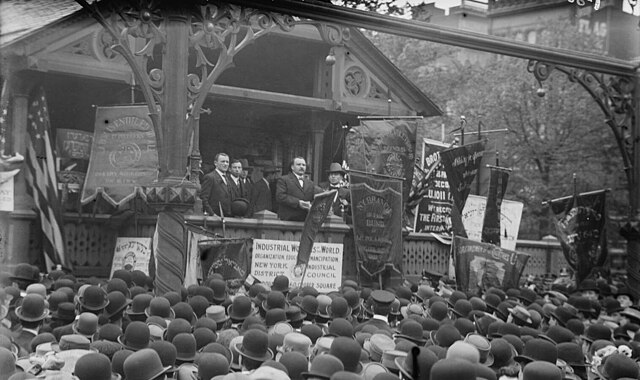
In 1903, Connolly decided to emigrate to the United States. His family joined him in 1904. It was at this time that the trade unionist movement of the “Wobblies” (Industrial Workers of the World, IWW) was created. Connolly asserted that industrial unionism is “simply the realisation that the workers are strongest at the point of production, that they have no other strength, and that by linking the revolutionary movement to daily struggles in the workshops, in the factories and in the shipyards, this economic force can be organised. The revolutionary organisation that this implies provides the basis for the future Socialist Republic.”
Connolly’s internationalism was not abstractly theoretical or sentimental. He put it into practice. He organised a section of the Wobblies in Newark, New Jersey. He worked for a building workers’ union, but also organised workers in the tramways, in the clothing industry, and on the docks. He participated in the presidential campaign of the socialist Eugene Debs and met with other great figures of the American labour movement, including William “Big Bill” Hayward. It was during this period of intense activity that he completed his book on the history of the revolutionary movement in Ireland, Labour in Irish History.
Return to Ireland, the ITGWU and the Dublin Lock-Out of 1913
Meanwhile, in Belfast in the north of Ireland, James Larkin had created the Irish Transport and General Workers’ Union (ITGWU), uniting Protestant and Catholic workers in a common organisation despite employers’ attempts to use religion to divide them. Larkin was already in prison when Connolly returned to Ireland in July 1910. Moving to Belfast, he joined the ITGWU and led the famous industrial strike of young women workers in October 1911.
In 1913, one of the greatest episodes of the class struggle in Irish history took place. The “Dublin lockout” was organised by the Employers’ Federation, with the aim of destroying the ITGWU. William Murphy, owner of the streetcars and a major media group, demanded that all his workers leave the ITGWU or else they would be sacked. When streetcar workers went on strike, 400 employers joined the “lockout,” denying access to some 25,000 workers until they resigned from the ITGWU and pledged never to strike. Larkin and Connolly were arrested. Larkin was sentenced to seven months in prison. It was during this conflict that the Irish Citizens’ Army was created, as a kind of “Red Guard” to protect strikers against armed attacks organised by employers and the police. The strike continued until the early months of 1914.
Upon his release from prison, Larkin left for the United States to collect the funds needed to rebuild the movement. Connolly became general secretary of the ITGWU and commander of the Irish Citizens’ Army. The outbreak of the First World War was accompanied by the collapse of the Socialist International. Almost all the national leaderships supported the imperialist carnage. But Connolly, like the Bolsheviks in Russia and Luxemburg and Liebknecht in Germany, resolutely opposed the war. Only a few days after the declaration of war, he explained the need for a revolutionary uprising to “light the fuse” of a European revolutionary conflagration. Clearly, Connolly saw a revolutionary uprising in Ireland not as a “national” event, but as part of an international revolution.
Insurrection – the Easter Rising
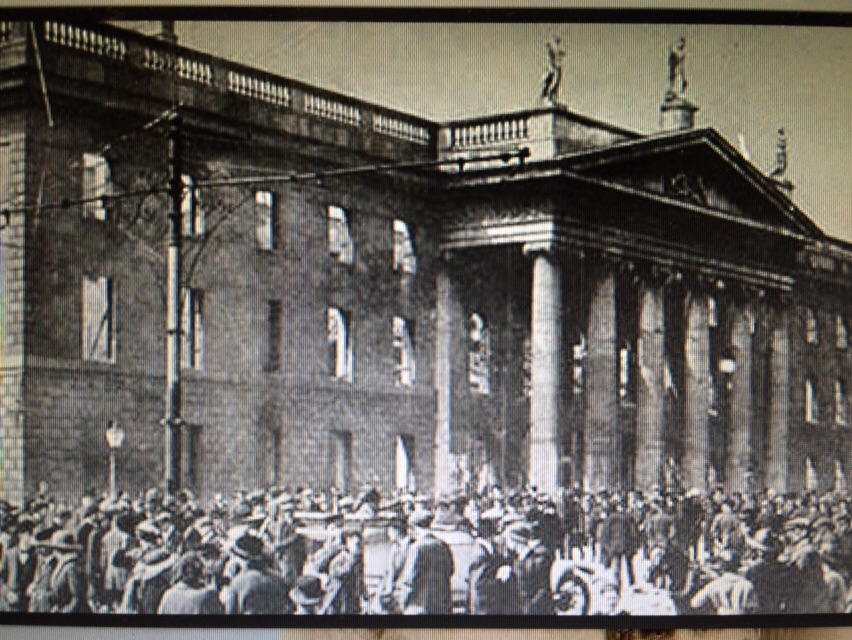
Connolly knew that such an insurrection could only be carried out through an alliance with the most radical wing of the nationalist militia, the Irish Volunteers. The movement had split in two over the question of war. The right wing supported imperialist war. The left wing, under the leadership of Padraic Pearse, opposed it. Pearse was not a socialist, but he was moving closer to Connolly’s ideas. It was he who drafted the Proclamation of the Republic which was read on the steps of the Dublin post office on 24 April 1916, thus giving the signal for the insurrection. The insurrection plan relied on the participation of the entire Volunteers and the Irish Citizens’ Army. But when the day came, the combined force of the two militias amounted to some 1,500 poorly armed men. The majority of the 12,000 Volunteers followed the instructions given by some of their leaders not to participate. As for the Irish Citizens’ Army, it mobilised only 220 fighting men. At the outbreak of the insurrection, Connolly had no illusions about the outcome. That morning, as he left ITWGU headquarters, he told his friend William O’Brien that they were both leaving to die. O’Brien asked him, “Is there really no chance of success?” Connolly replied, “No. None. »
The fighting lasted seven days, until the surrender of the insurgents on 30 April. Some 1400 people were killed or seriously injured. Nearly 200 buildings in the centre of Dublin were destroyed. The military tribunal sentenced 90 insurgents to death. Thousands more were incarcerated in England. Executions began on 3 May. Padraic Pearse was shot on that day. Connolly, dying of his gangrenous wounds, was tried in his bed and, a few days later, tied to a chair and shot.
The Irish insurrection thus ended in a terrible defeat. But it was part of a wider process of the emergence of the international revolutionary movement caused by the World War. The course of the insurrection and its lessons were studied and widely commented on by internationalists in other countries. A few months before the outbreak of the Russian Revolution of 1917, Lenin wrote:
“The term “putsch,” in its scientific sense, may be employed only when the attempt at insurrection has revealed nothing but a circle of conspirators or stupid maniacs, and has aroused no sympathy among the masses. The centuries-old Irish national movement […] manifested itself in street fighting conducted by a section of the urban petty bourgeoisie and a section of the workers after a long period of mass agitation, demonstrations, suppression of newspapers, etc. Whoever calls such a rebellion a “putsch” is either a hardened reactionary, or a doctrinaire hopelessly incapable of envisaging a social revolution as a living phenomenon.
To imagine that social revolution is conceivable without revolts by small nations in the colonies and in Europe, without revolutionary outbursts by a section of the petty bourgeoisie with all its prejudices, without a movement of the politically non-conscious proletarian and semi-proletarian masses against oppression by the landowners, the church, and the monarchy, against national oppression, etc., is to repudiate social revolution. Whoever expects a “pure” social revolution will never live to see it. […]
It is the misfortune of the Irish that they rose prematurely, before the European revolt of the proletariat had had time to mature. Capitalism is not so harmoniously built that the various sources of rebellion can immediately merge of their own accord, without reverses and defeats. On the other hand, the very fact that revolts do break out at different times, in different places, and are of different kinds, guarantees wide scope and depth to the general movement; but it is only in premature, individual, sporadic and therefore unsuccessful, revolutionary movements that the masses gain experience, acquire knowledge, gather strength, and get to know their real leaders, and in this way prepare for a general onslaught.”
Throughout his entire conscious life, James Connolly fought against capitalism and for the emancipation of the working people. Coming from a working-class family, he was himself a worker. Never opportunist nor self-seeking, he did not use politics to enrich himself. Orator, writer, theoretician, revolutionary militant, internationalist, his ideas and his actions deserve to be seriously studied by all those who are engaged in the struggle for socialism in our own time.
All images from Wikimedia Commons
https://commons.wikimedia.org/wiki/File:James_Connolly_addresses_crowd_in_NYC,_1908.jpg
https://commons.wikimedia.org/wiki/File:James_Connolly2.jpg
https://commons.wikimedia.org/wiki/File:GPO_1916.jpg