
By Joe Langabeer
Last year was the 250th birthday of Jane Austen. Because of this, I decided to read one of Austen’s works for the first time. Emma is one of her most beloved books, primarily due to the complex nature of Emma as a character. She is a flawed hero who makes mistakes based on her naivety towards others’ thoughts and feelings. But what I did not expect was the critique and satirical nature of Austen’s writing about the upper classes. It is a funny, mischievous book discussing the role of women in “high society”, and is well worth a read.
[WARNING – this review contains spoilers for the book]
The book begins with the “loss” of Mrs Weston, a governess for Emma and the Woodhouse family. She marries Mr Weston and leaves the Woodhouse estate. Emma, whilst putting on a brave face for Mrs Weston, is left with her hypochondriac father, Mr Woodhouse, who laments his sadness over the “loss” of Mrs Weston.
In many ways, Mr Woodhouse entraps Emma through his own grief over losing his wife, and pressures Emma, a young woman who wants the freedom to be young, to stay close to him and give in to his hypochondriac fears.
This is all set within the fictional Surrey village of Highbury. It is a small village in which many of the rich have very little to do, so gossip about others is commonplace.
If something as mediocre as a marriage is announced, or a scandal occurs amongst friends and lovers, then the rich talk and judge based upon their own “superior” morals. Emma is both a critic of this, but ultimately succumbs to indulging in this type of judgement, unable to free herself from the culture of the wealthy that surrounds her.
Even in the first sentence describing Emma, Austen makes us aware that whilst she is ‘handsome’ and clever, she is also wealthy, and that throughout her life she has had very little to distress her. Yet often, Emma is looking for that distress, casting her conviction or doubt amongst other characters through her obsession with status when characters are romantically interested in one another.
She ends up playing matchmaker to other characters, including Harriet, who Emma initially believes has little status in life. Emma does this partly because of boredom, but there is also an ignorance there that Austen is critical of within the upper classes.
Status and power
The obsession with status, wealth, power and marriage is all meaningless when it comes to love. However, Austen also recognises in her writing that status traps women within their choices, with Emma originally choosing not to marry, though in the end marrying because she too is part of a system where she needs to protect herself.
It is not a forced marriage, as she realises that she is in love with Mr Knightley, a childhood friend who challenges her on her choices throughout the book, but women in society, if they were to survive in this period, had to secure comfort through marriage.
Emma misunderstands Harriet’s character, who is later revealed towards the end of the book to be the natural daughter of a fairly successful tradesman. She dismisses Harriet’s interest in Mr Martin towards the beginning of the book because Emma believes he is not her social equal.
Instead, she tries to set Harriet up with Mr Elton, a young vicar from the local parish. Mr Knightley warns Emma about Mr Elton, but she disregards Knightley’s concerns, only for Mr Elton to confess his love for Emma. After Emma rejects Mr Elton’s advances, he becomes very vindictive and bitter towards her.
Mr Elton then marries Mrs Elton, formerly Miss Hawkins, who is one of the most insufferable characters in the book. She is pretentious, spoilt, and talks only about the trite affairs that interest her, often boasting about her wealth and what she does with it.
Mrs Elton also becomes obsessed with Jane and her aunt, Miss Bates, both of whom live in poverty. The dynamic between these three indicates that wealth does not equate to gentility, despite gentility often being associated with the rich. Jane and Miss Bates, whilst having their own complicated narratives throughout the book, are respectable and kind people.
But Emma, through her naivety and poor judgement, initially loathes Jane. This coincides with the arrival of Frank Churchill, whose mother died when he was young and who was raised by his aunt and uncle. He is also the son of Mr Weston from his first marriage, before Weston married Mrs Weston.
Frank proceeds to cause chaos between Emma and Jane, flirting with Emma and confessing his thoughts to her whilst making mean-spirited comments towards Jane. It comes to a head at a picnic towards the end of the book, when both Frank Churchill and Emma use their privilege to mock and humiliate Jane and Miss Bates, primarily because they are bored.
Class dynamics
And this is where we see the class dynamics on full display in the book. Both Churchill and Emma come from wealth, yet they cannot see, at least for now, how their crass behaviour affects those trapped within their social status. Whilst this moment sets the stage for Emma to change her ways and become closer to Jane and Miss Bates, it is this type of criticism from Jane Austen which shows how cruel the wealthy can be towards the poor, simply because they are protected by their wealth and status.
At the end of the book, Jane ends up marrying Frank Churchill, as it is revealed that he wanted to marry her all along. Emma marries Mr Knightley, and Harriet, who is desperate to find herself a husband and has many missteps along the way brought about by Emma, marries Mr Martin. It is a brief jubilation, with the ceremony not receiving much focus because of Jane Austen’s criticism of the idea that women must marry to protect or raise their status in society.
Instead, Austen ends the book with shallow commentary from Mrs Elton about these weddings being inferior to hers, once again mocking the vanity of the ruling class, without them ever exploring the lack of freedom that comes because of the institution of marriage.
The role of women
I think back to The Origin of the Family, Private Property and the State by Friedrich Engels. In the book, Engels comments on how, through the rise of the patriarchal family alongside private property and legal marriage, women became subordinated within the household, with the husband holding power through wealth and inheritance. Even when industrial capitalism brought women into wage labour, they still remained burdened by domestic labour in the home. In essence, women had little control over either their labour or their social position.
Jane becomes the biggest casualty of all the young women in the book. Before Frank admits that he loves her, she is being forced into working as a governess so that she can get by. It is only when Frank decides to be with her that she is given the illusion of choice.
Marriage, both then and, to some extent, now, though far less so, is an elevation or protection of status that grants some security to women, but not by much. In truth, the patriarchal family gives no real freedom to women, and even though these characters need it to protect themselves, it does not mean they are freer because of it, only safer.
It is Austen’s commentary on the role of women in society that should be praised, especially when reading a book such as Emma. Many commentators, many of them men, alongside the Hollywood effect of romanticising these adaptations, miss the critiques Austen was attempting to make. Even I fell into that initial belief, having read none of her work before.
Emma made me think more deeply about the role of women and how they are forced to be subservient to the laws of patriarchy through marriage and status, and that is why Austen, as an author, should not be scoffed at, but explored with deeper examination and praised for the critique she was attempting to make. Emma is a rebellious read for its time, and I would recommend socialists read it to understand the role of women in that period and what it represents for our values of marriage in the modern world.
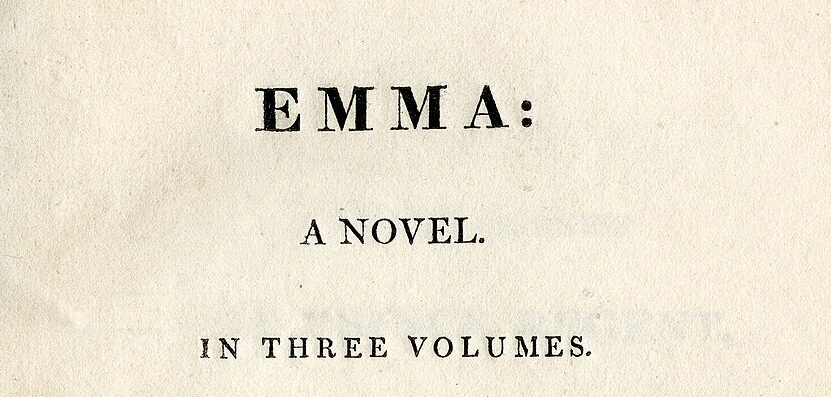
[Feature picture of the book Emma is from Wikimedia Commons, here]